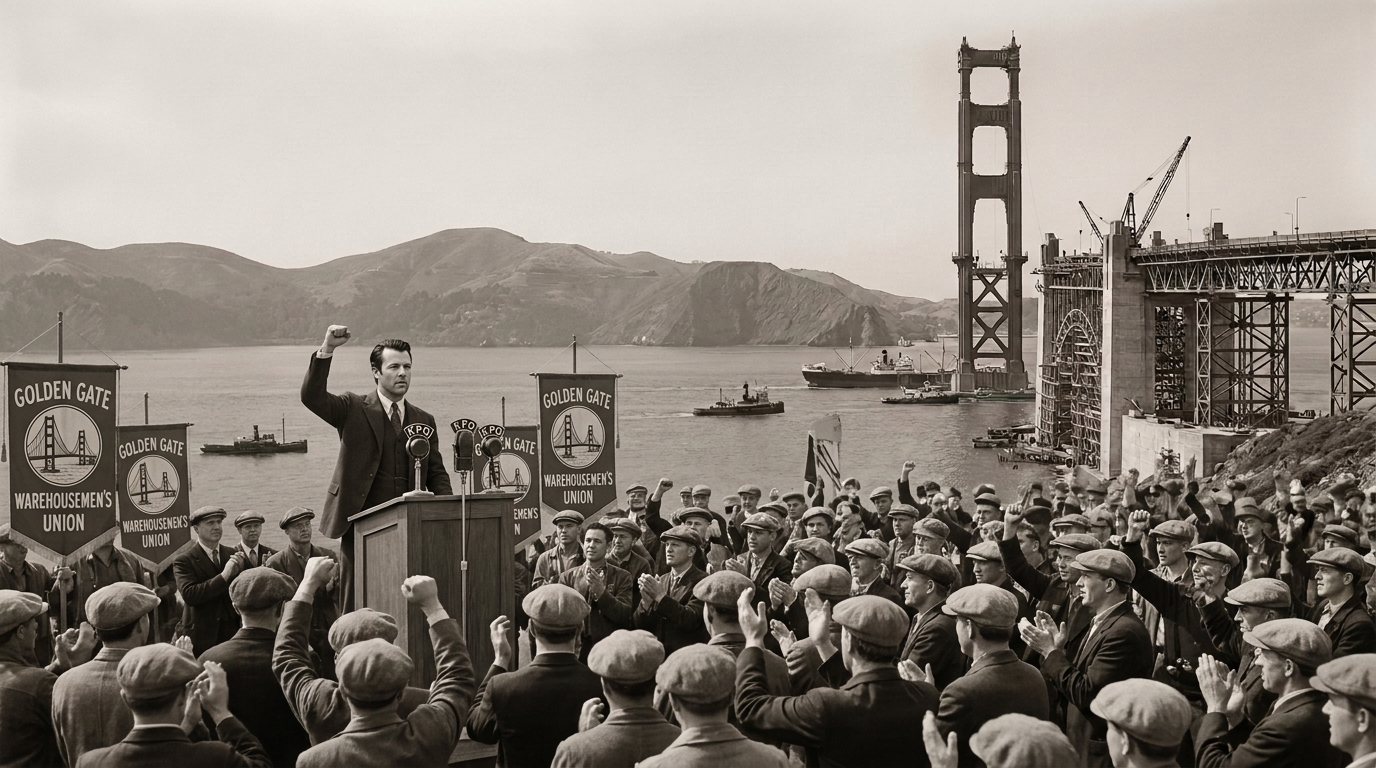
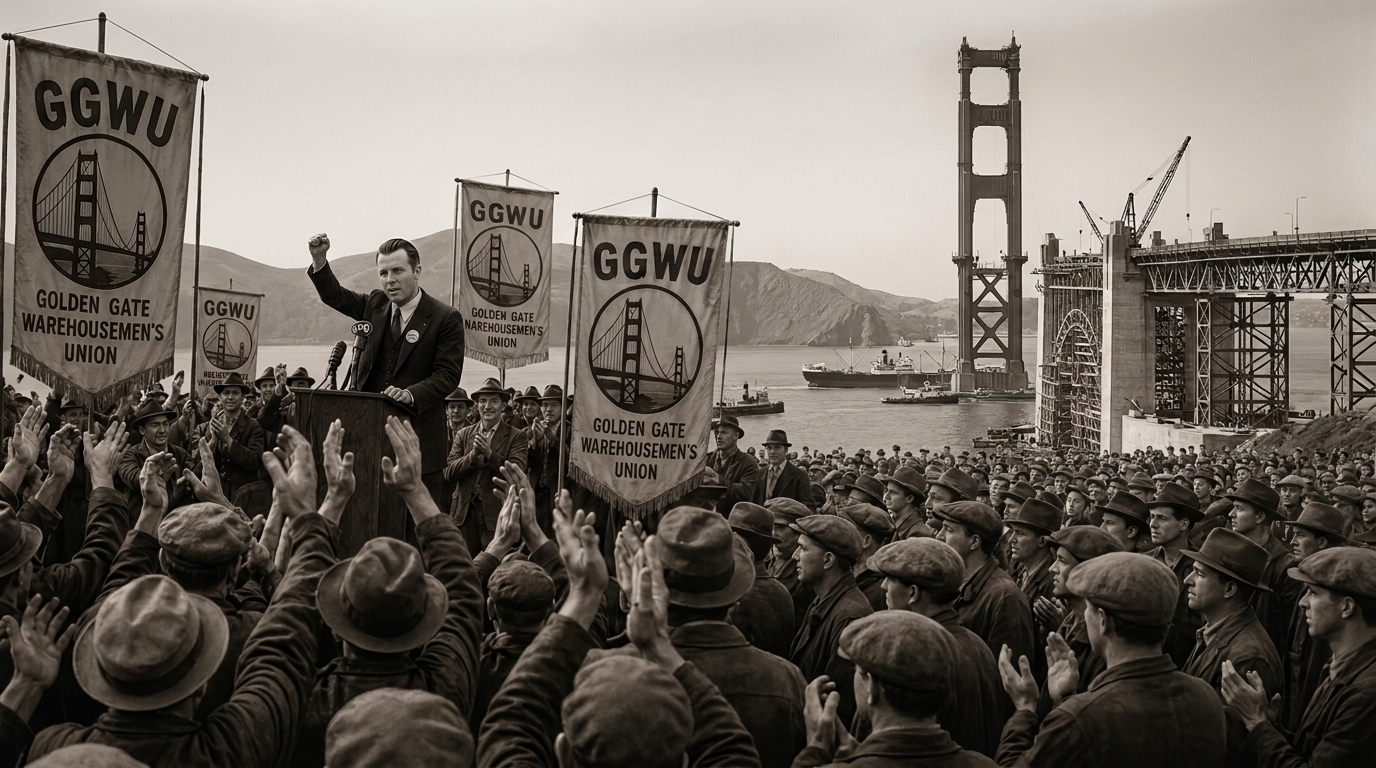
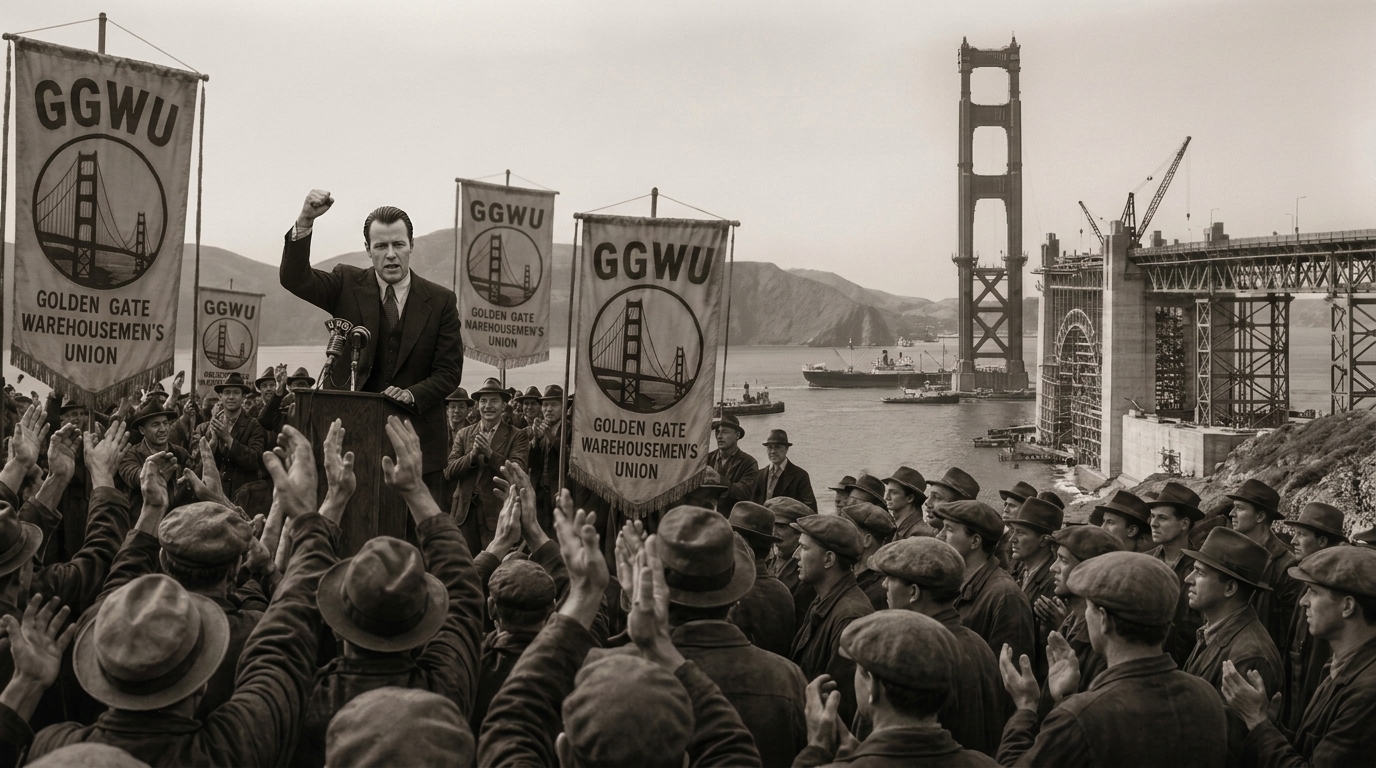
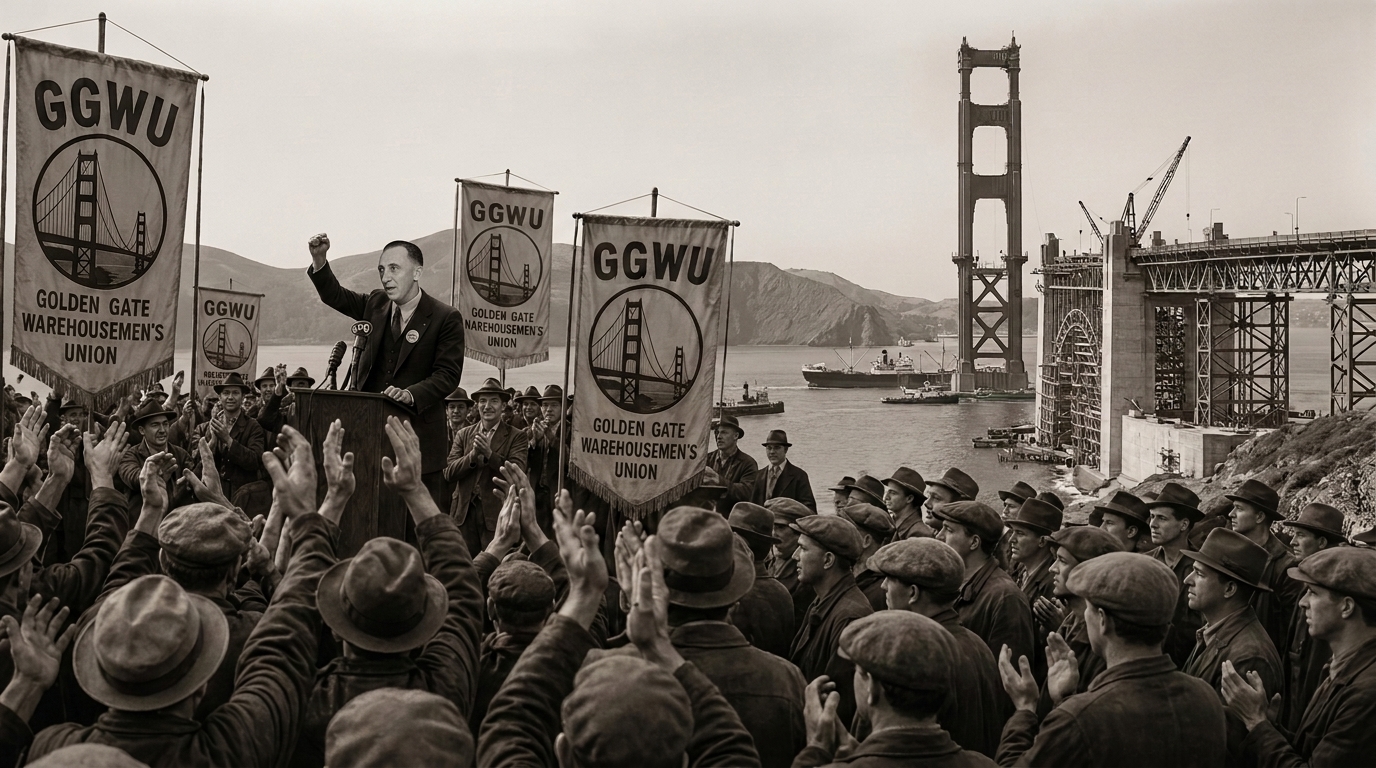
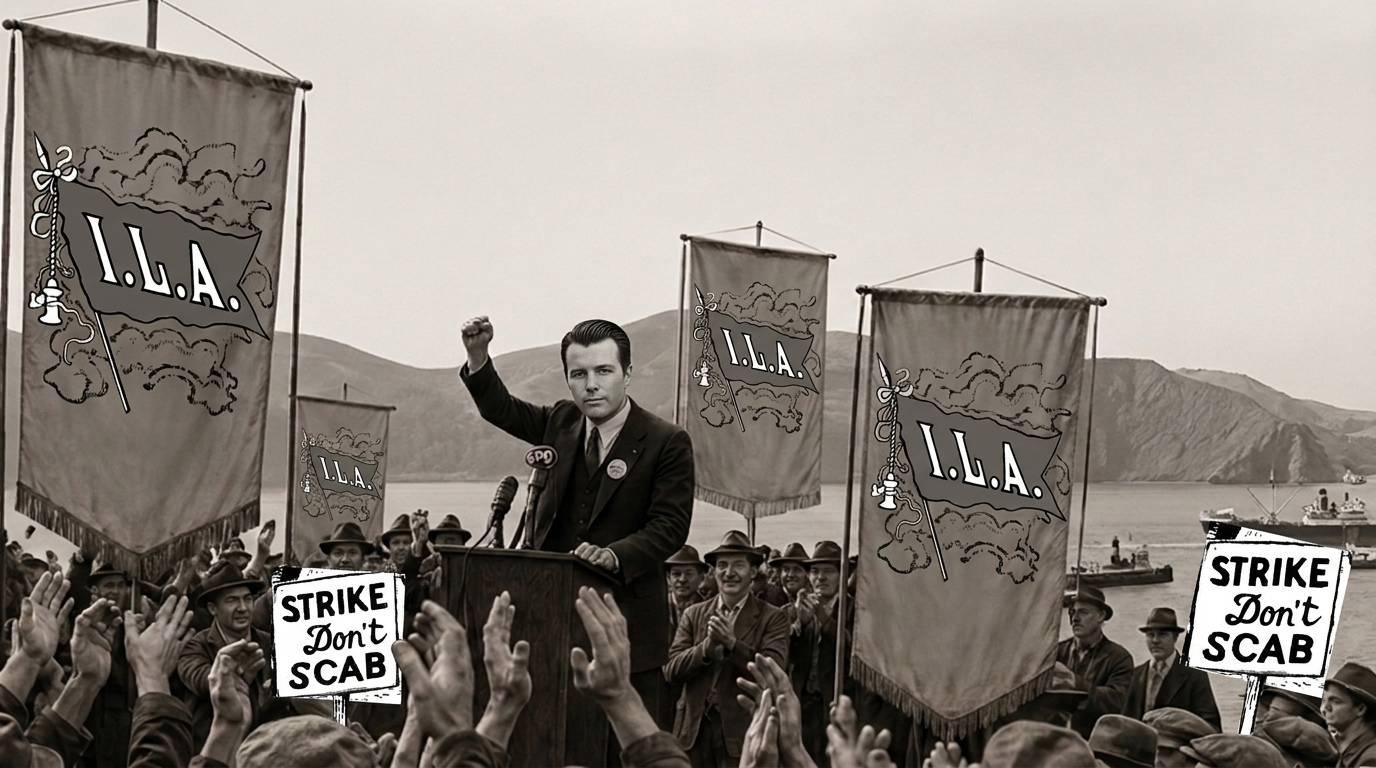
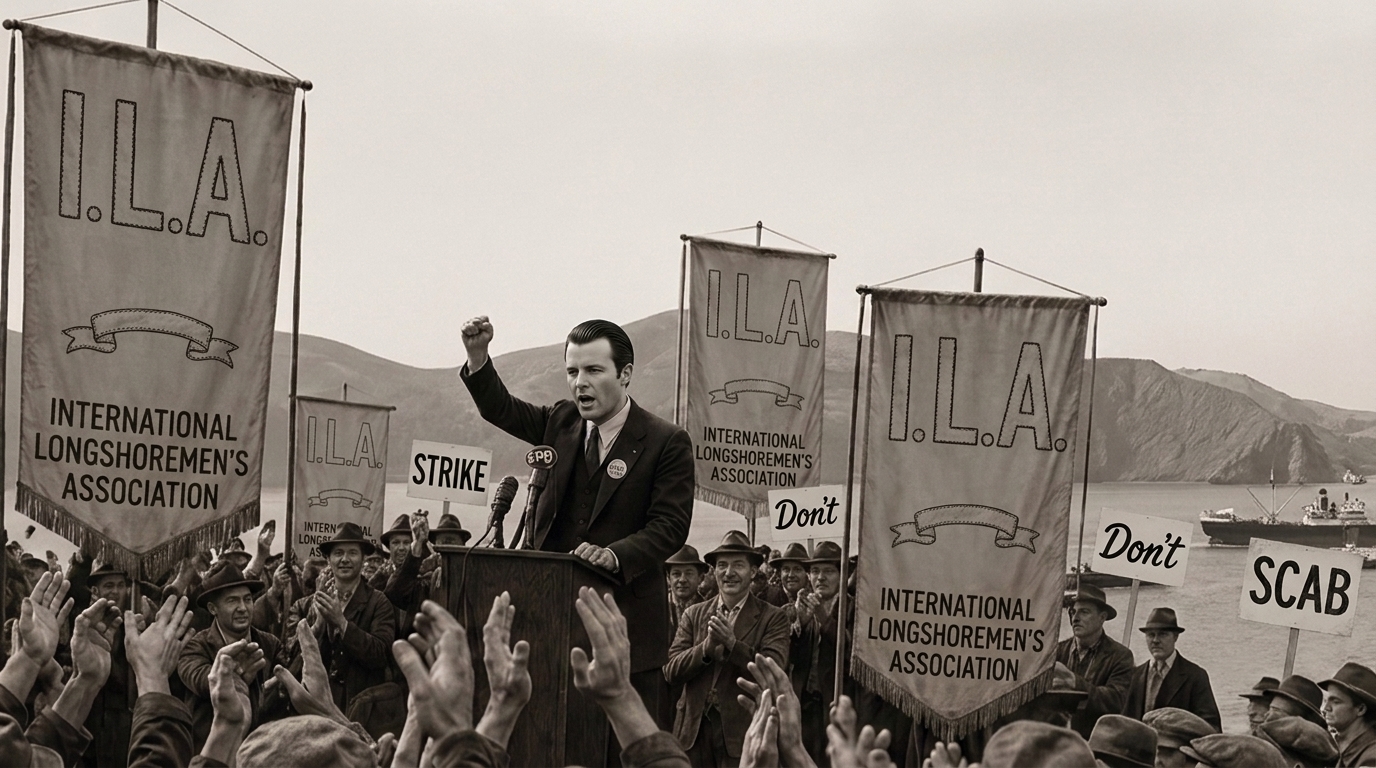
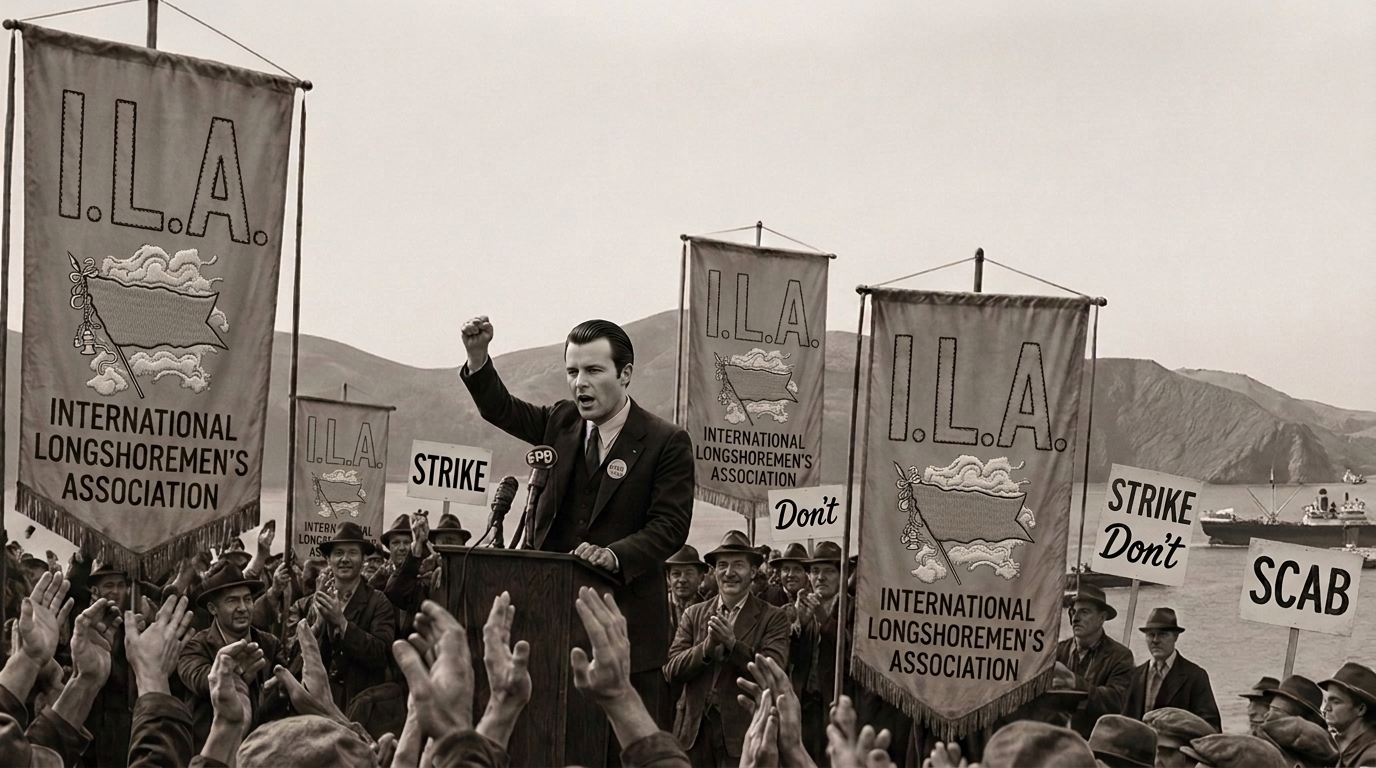
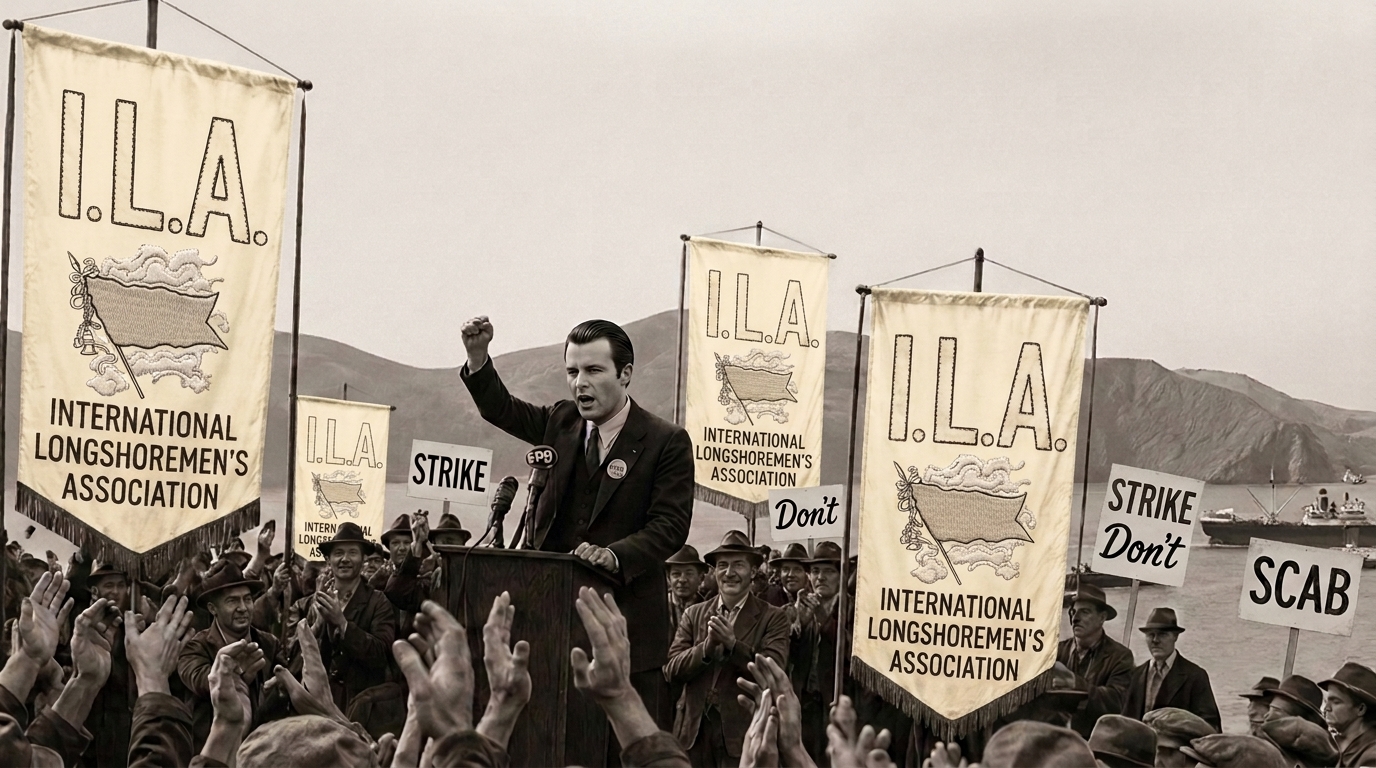
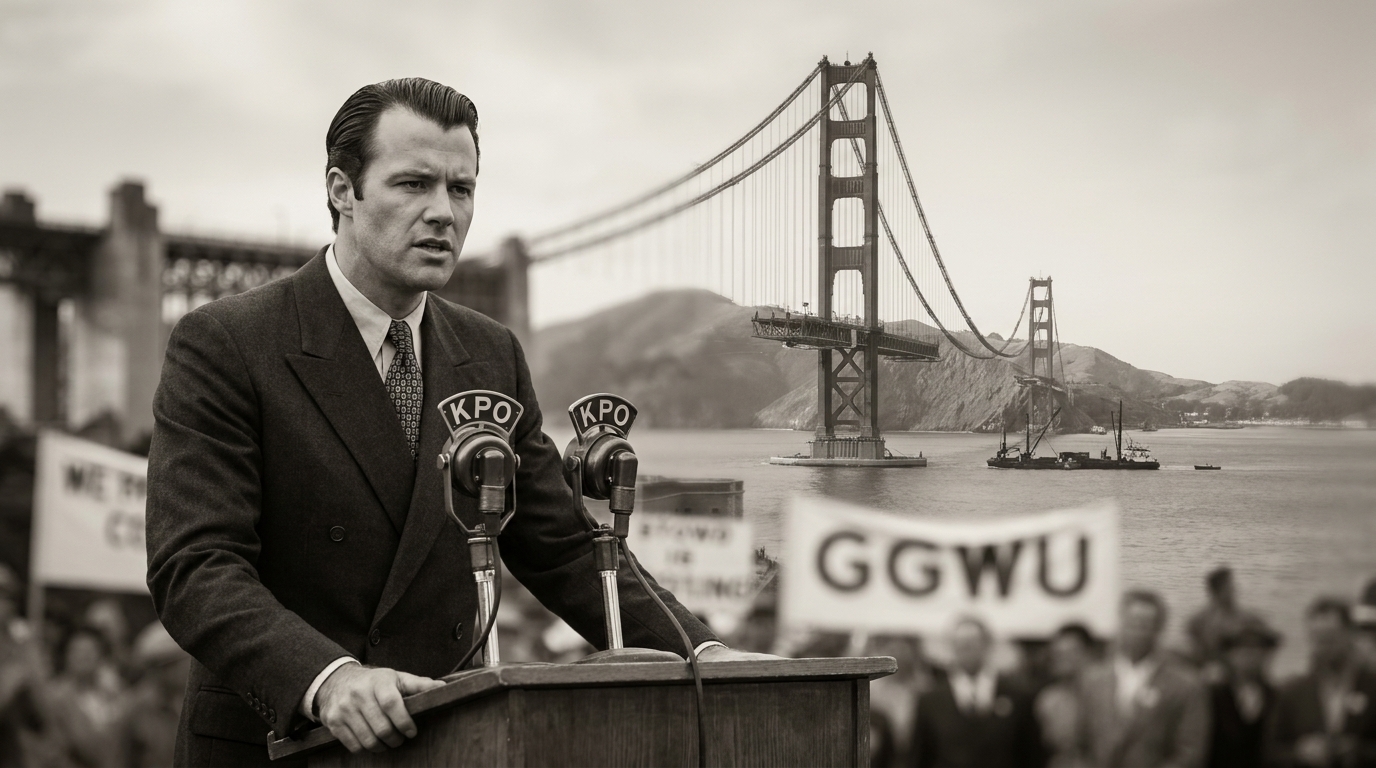
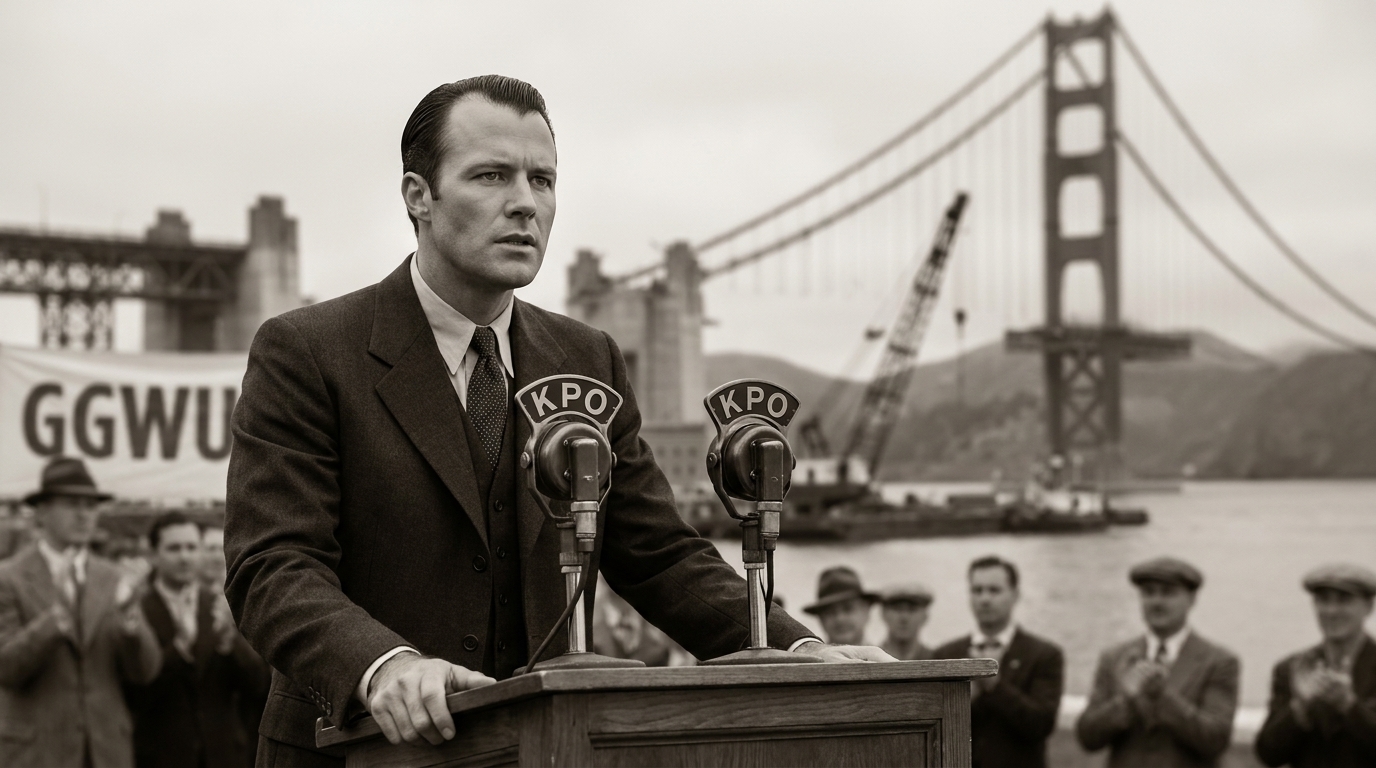
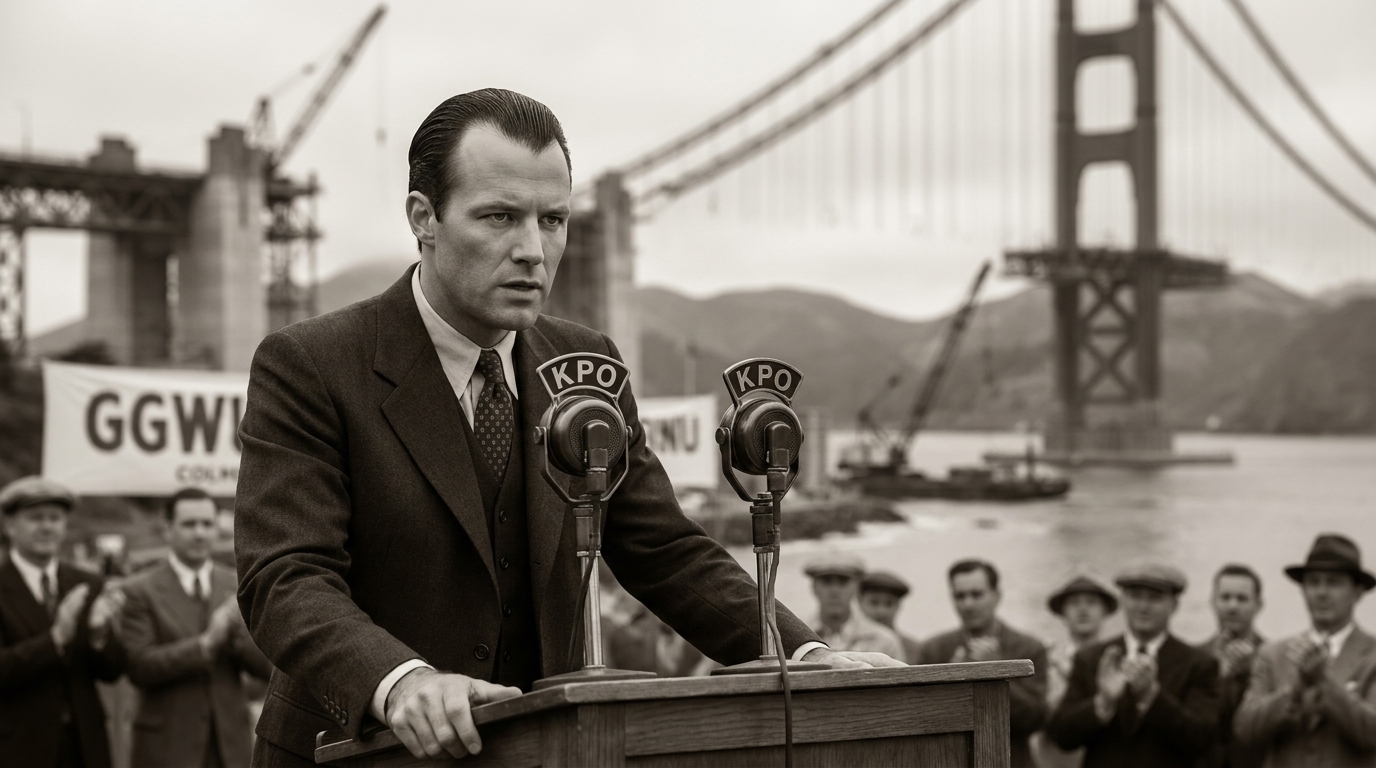
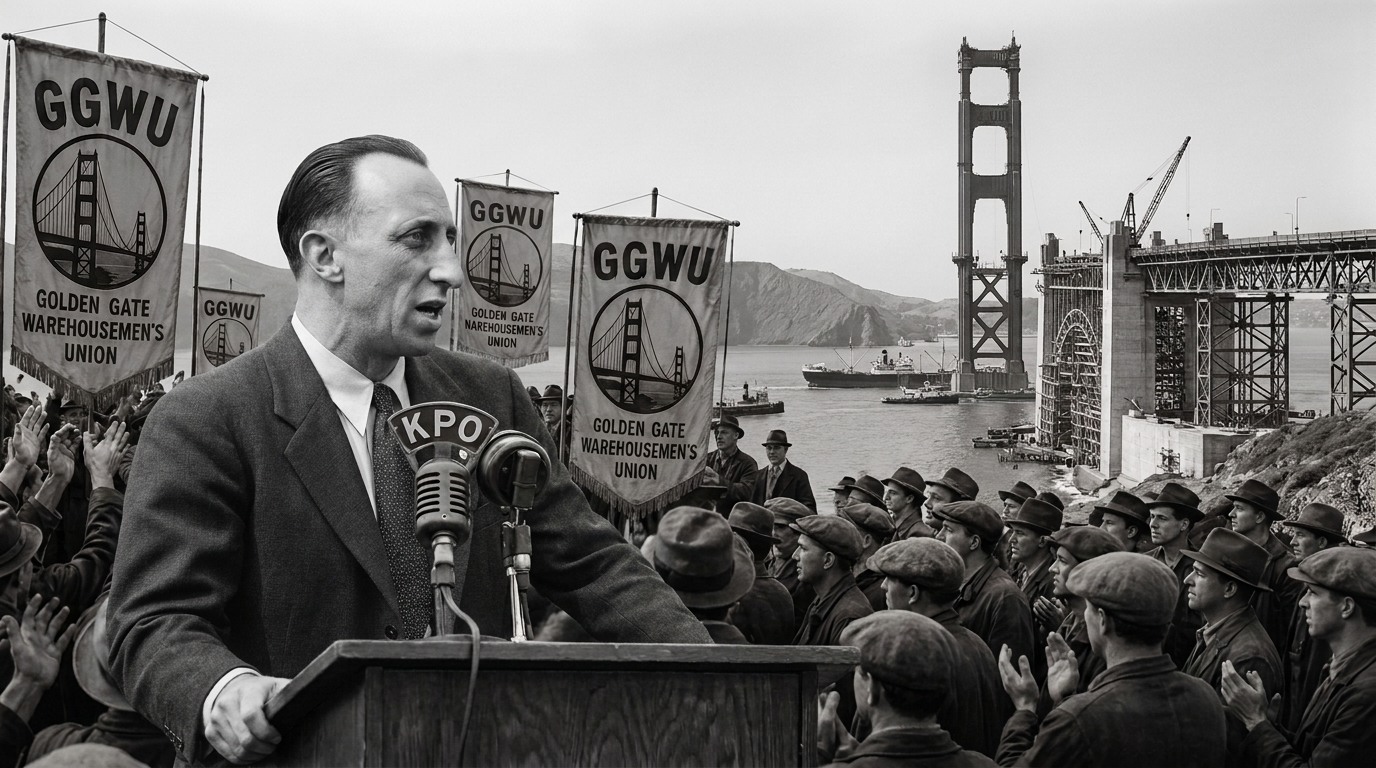
Period-accurate 1933 clean black-and-white documentary press photograph, WIDE LANDSCAPE 16:9. Clean archival still only: NO film grain, NO dust, NO scratches, NO vignette, NO gate weave, NO emulsion damage.
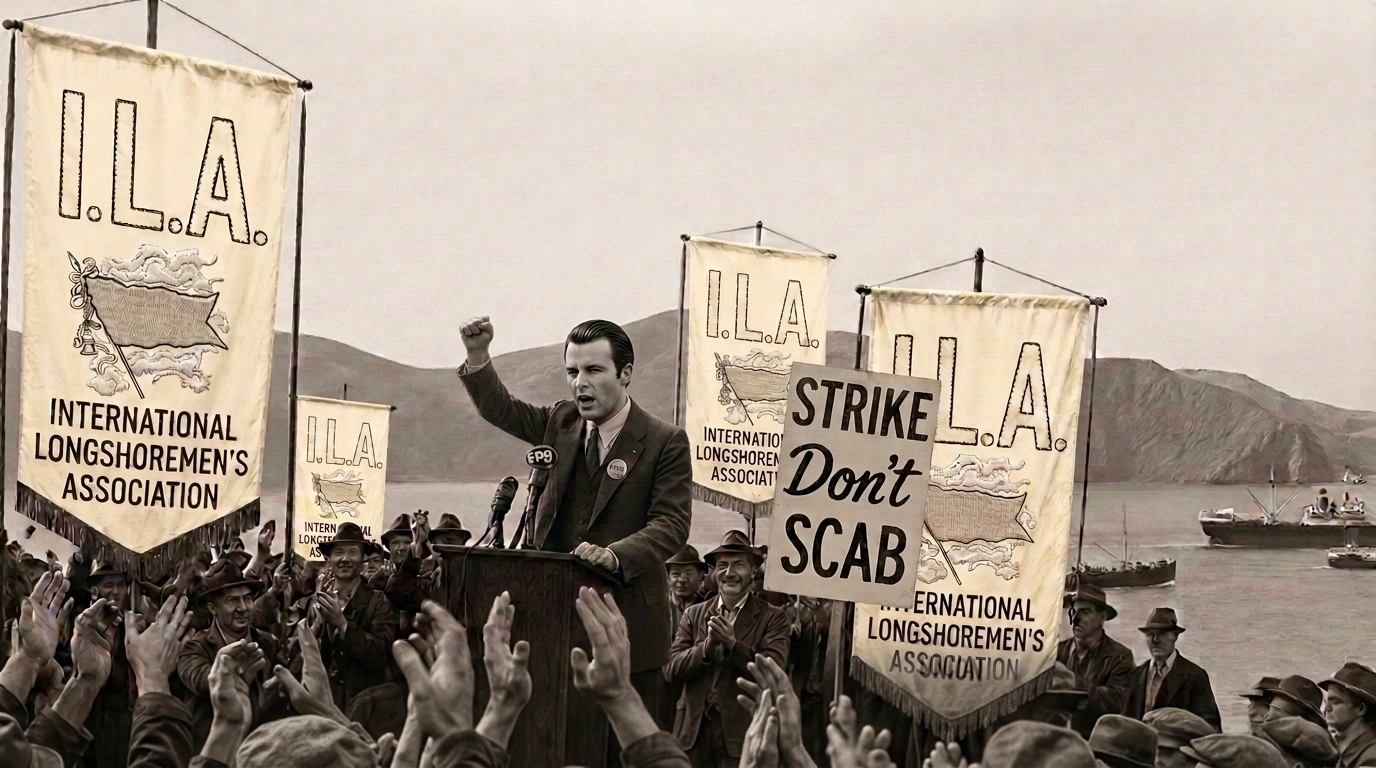
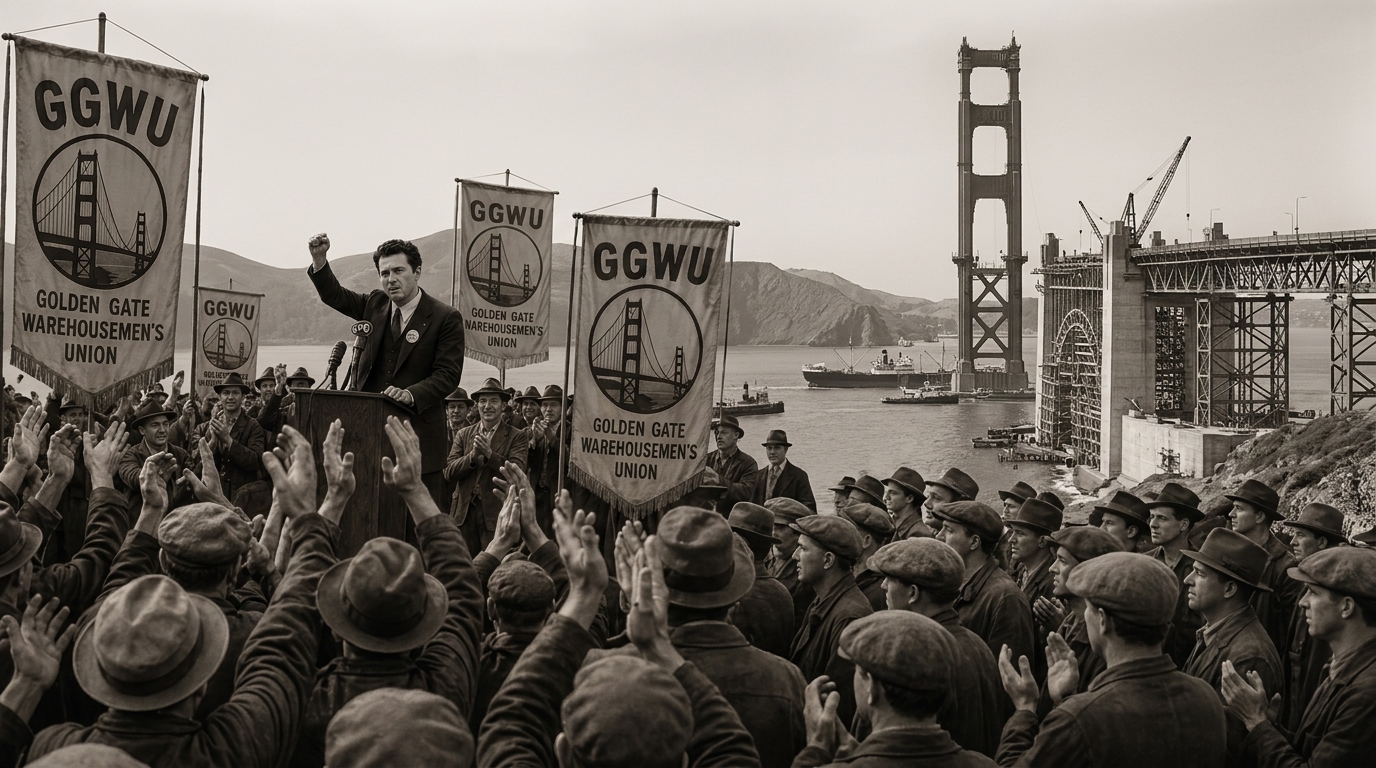
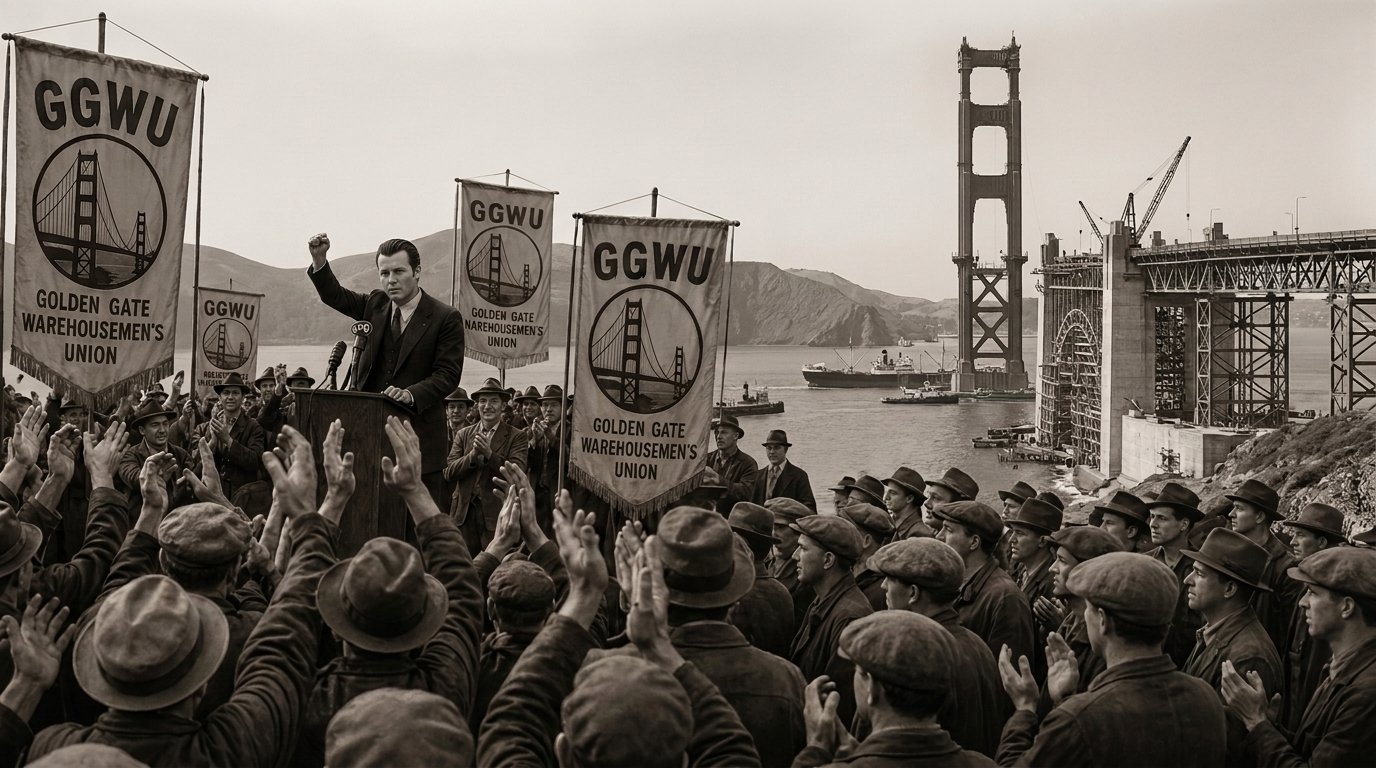
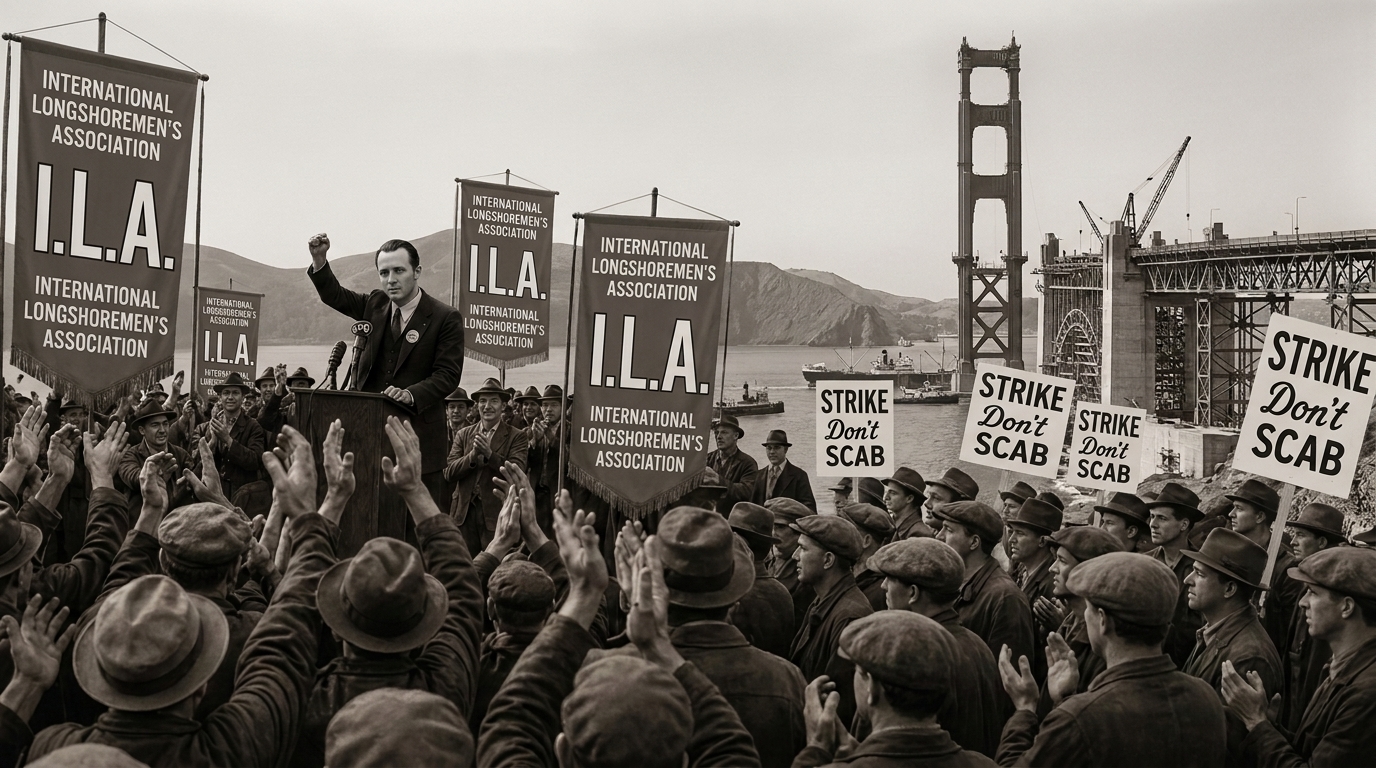
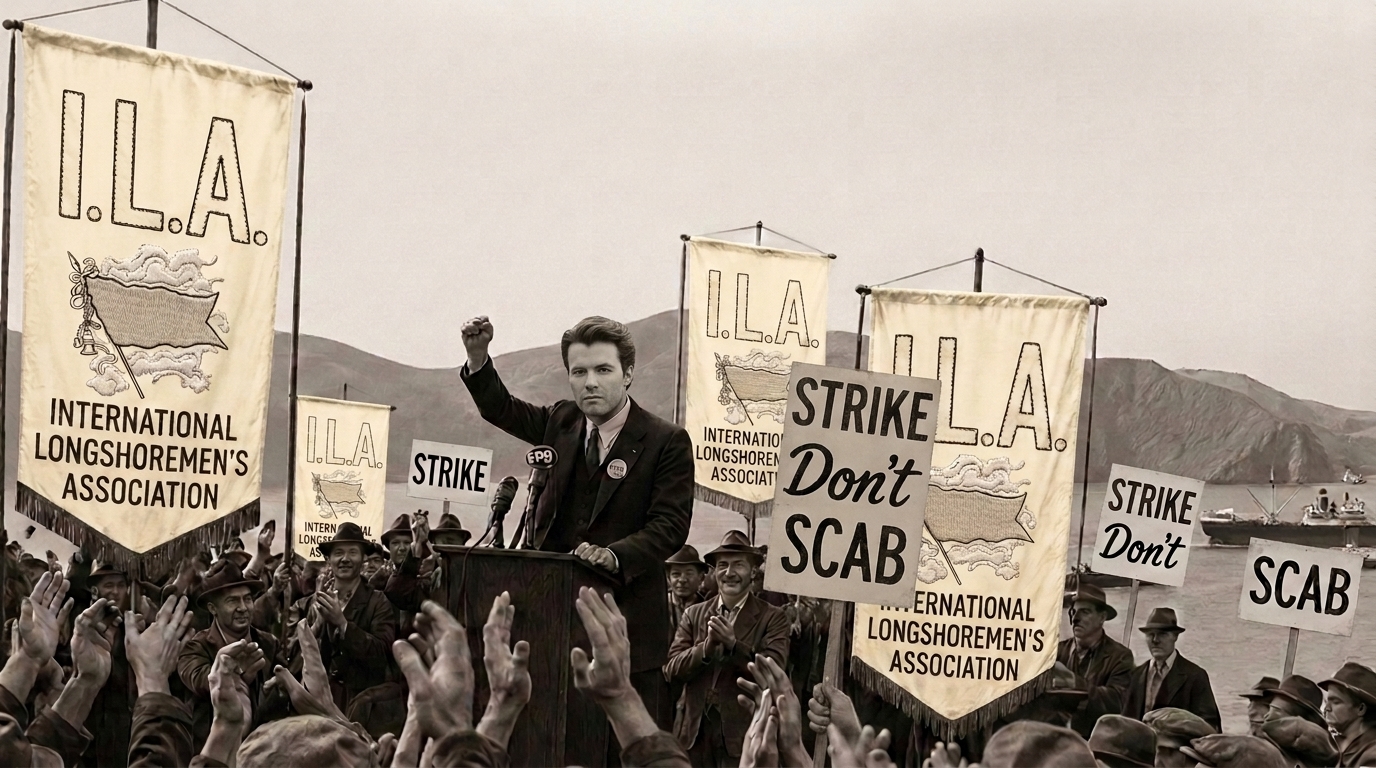
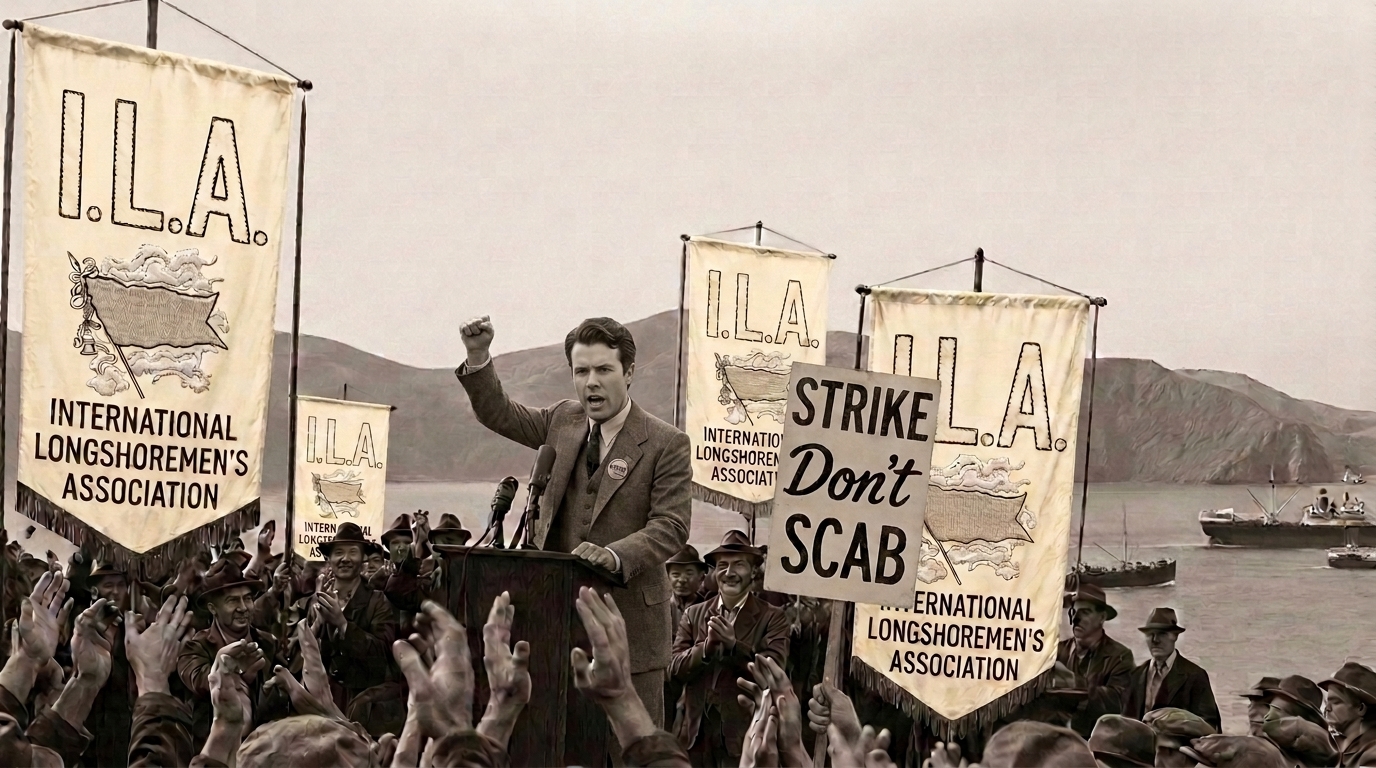
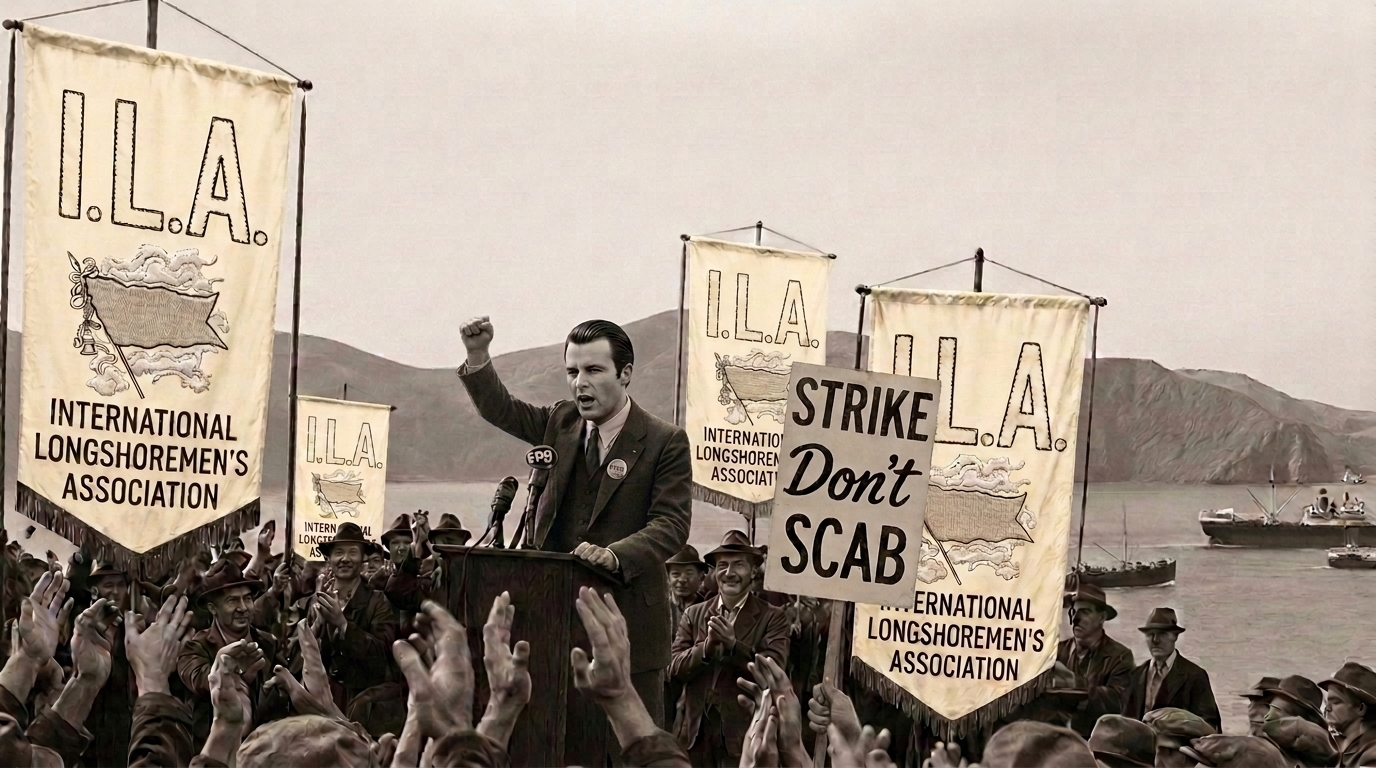
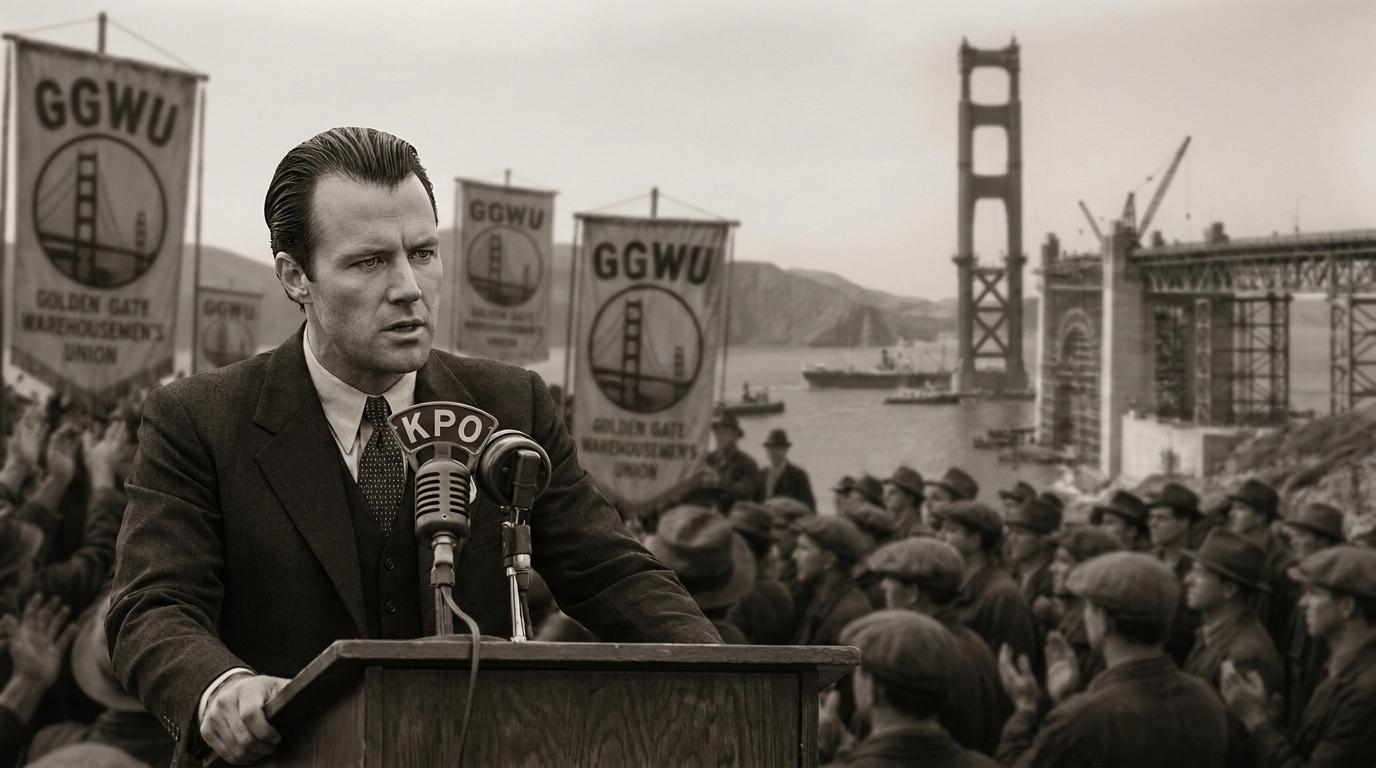
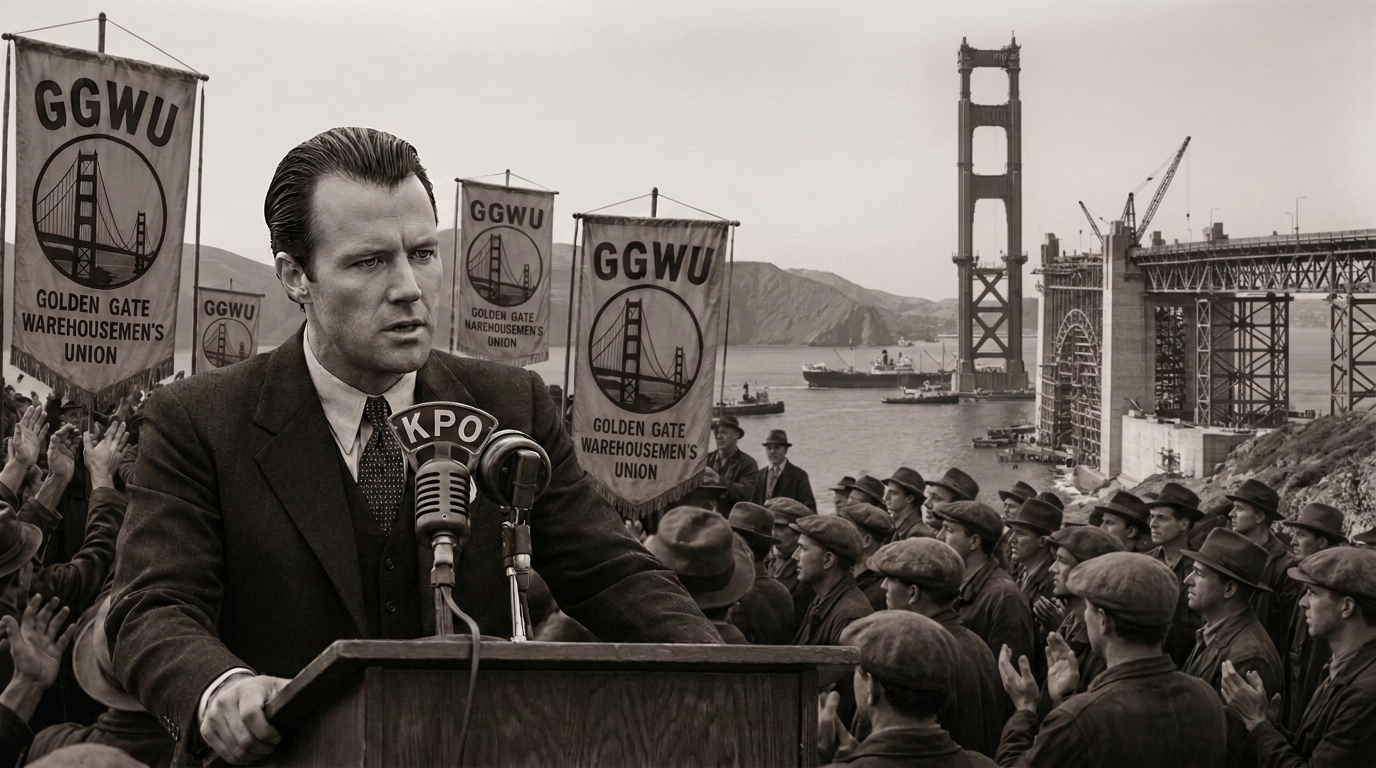
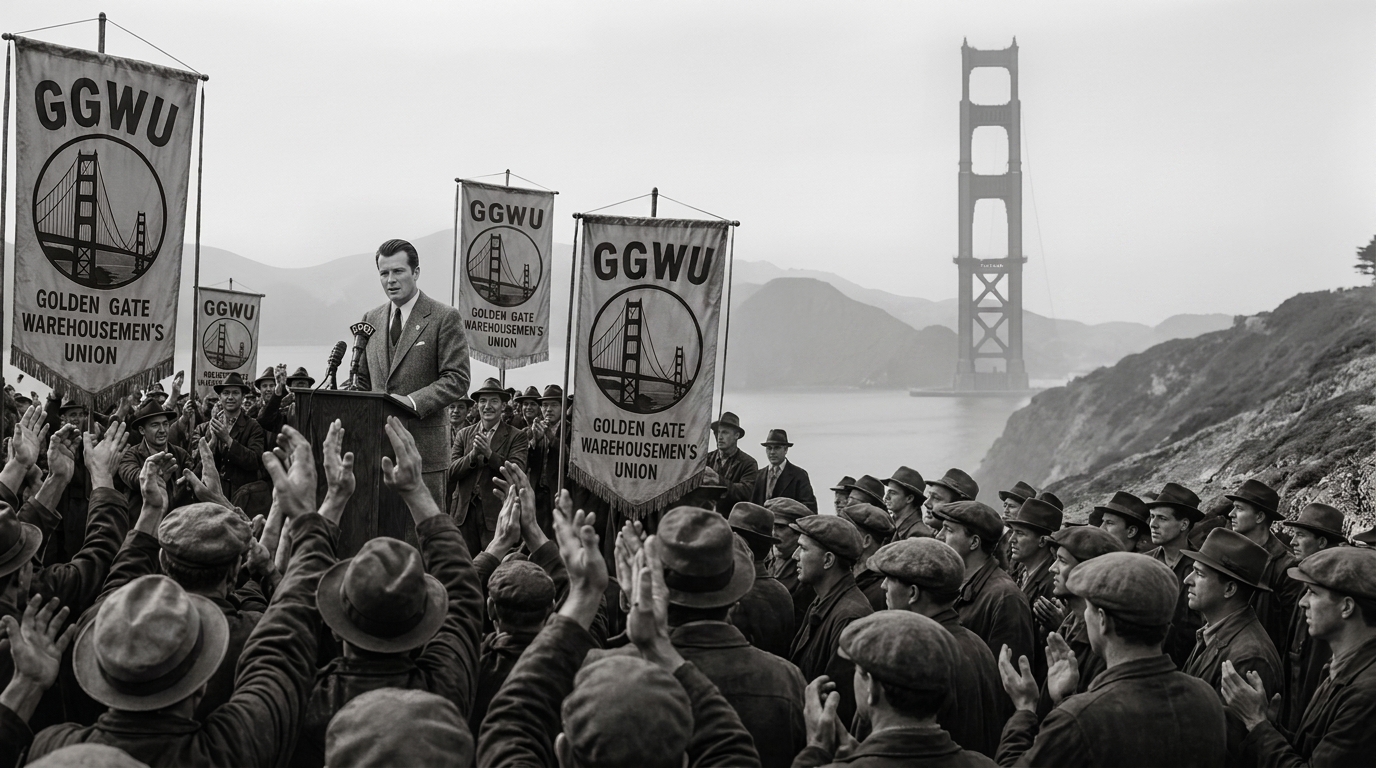
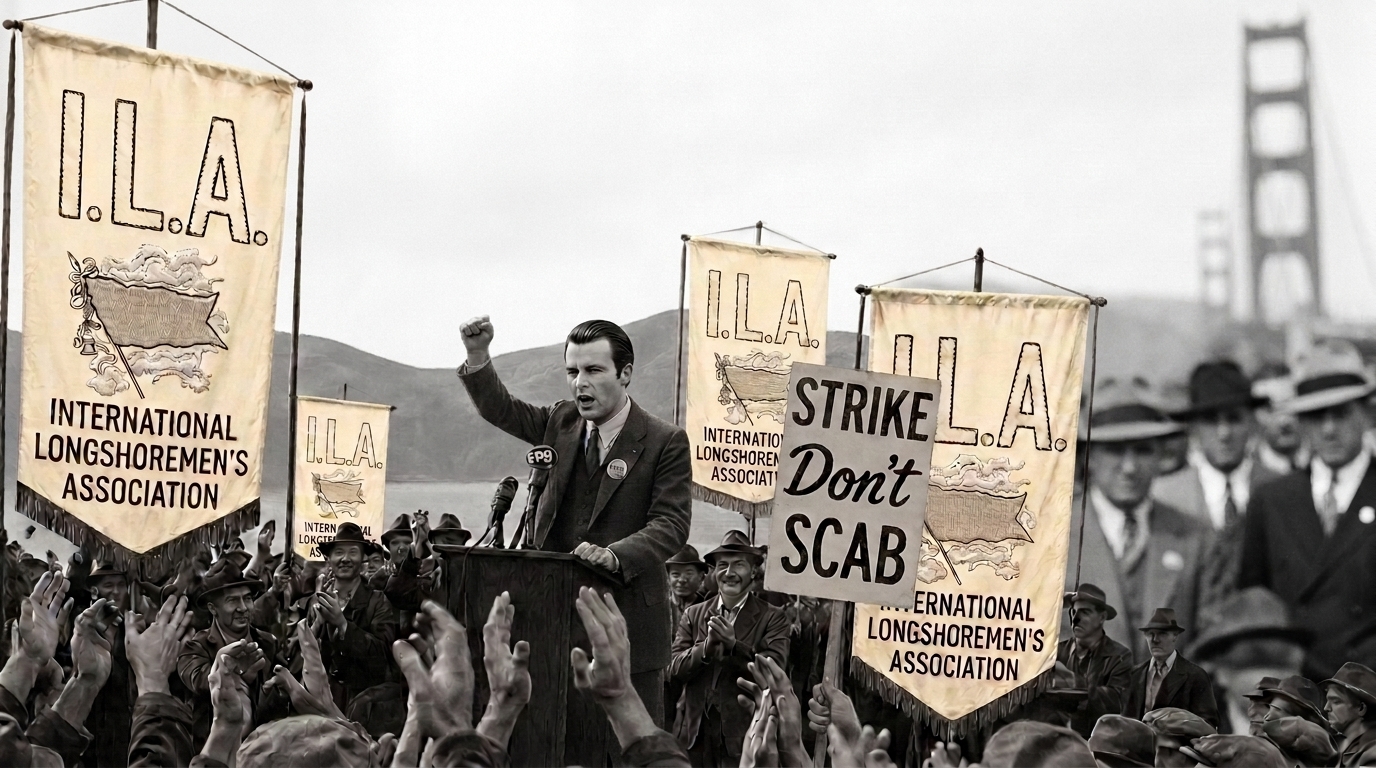
Reference image 1 is a feathered PIL composite of two real photographs of the same 1933 ILA rally. It already shows the exact target composition. Your job is to produce a clean photographic version of reference image 1 - all the same elements, all in the same positions, but with the soft alpha-feathered seam smoothed away so the result reads as ONE continuous press photograph rather than two photographs blended together.
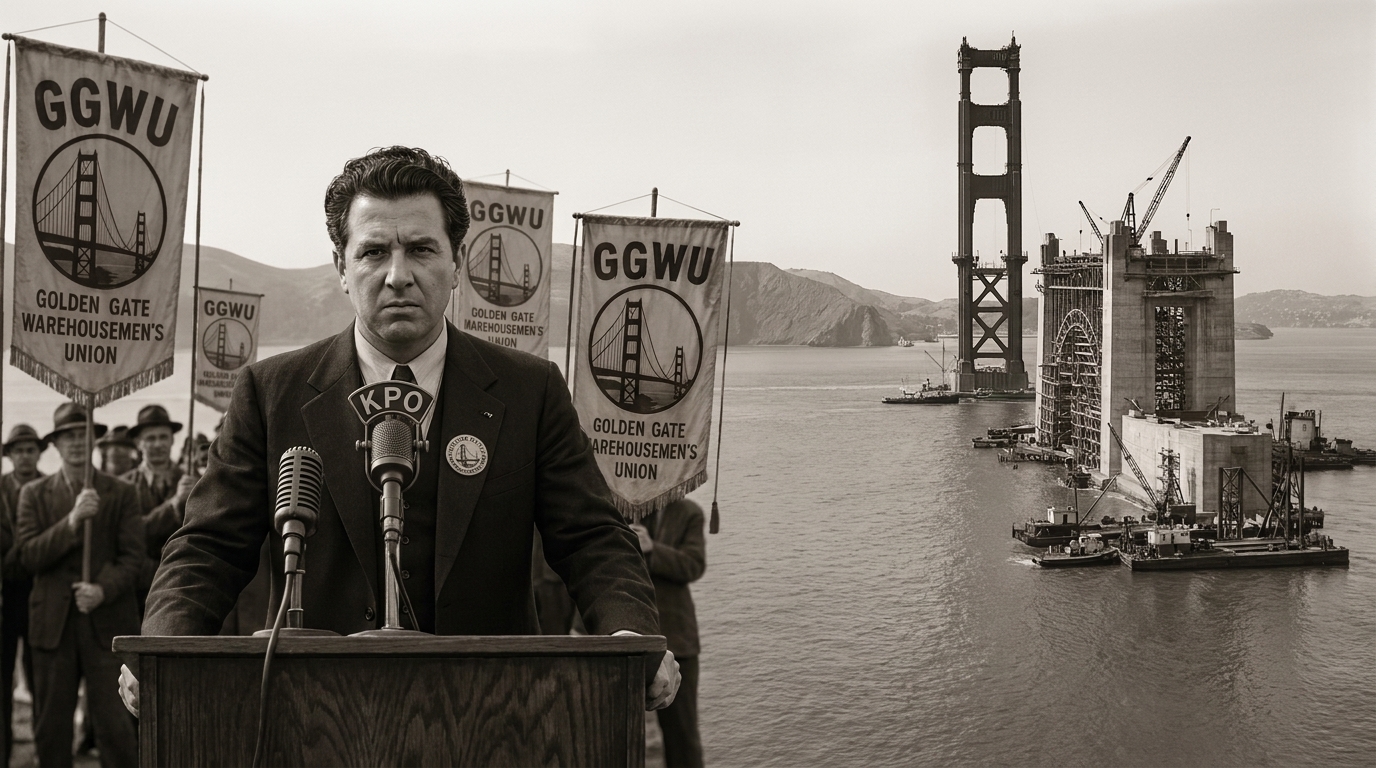
WHAT MUST MATCH REFERENCE IMAGE 1 (the composite) EXACTLY:
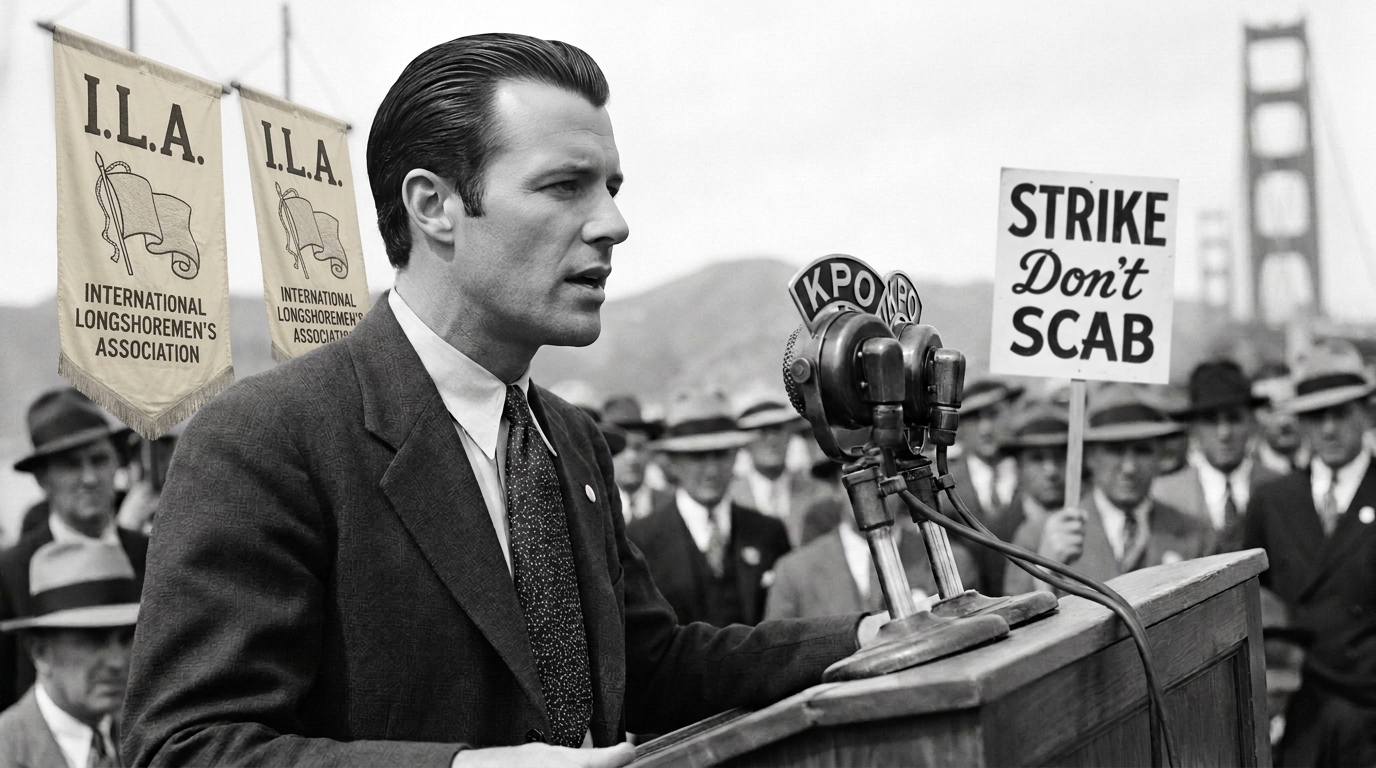
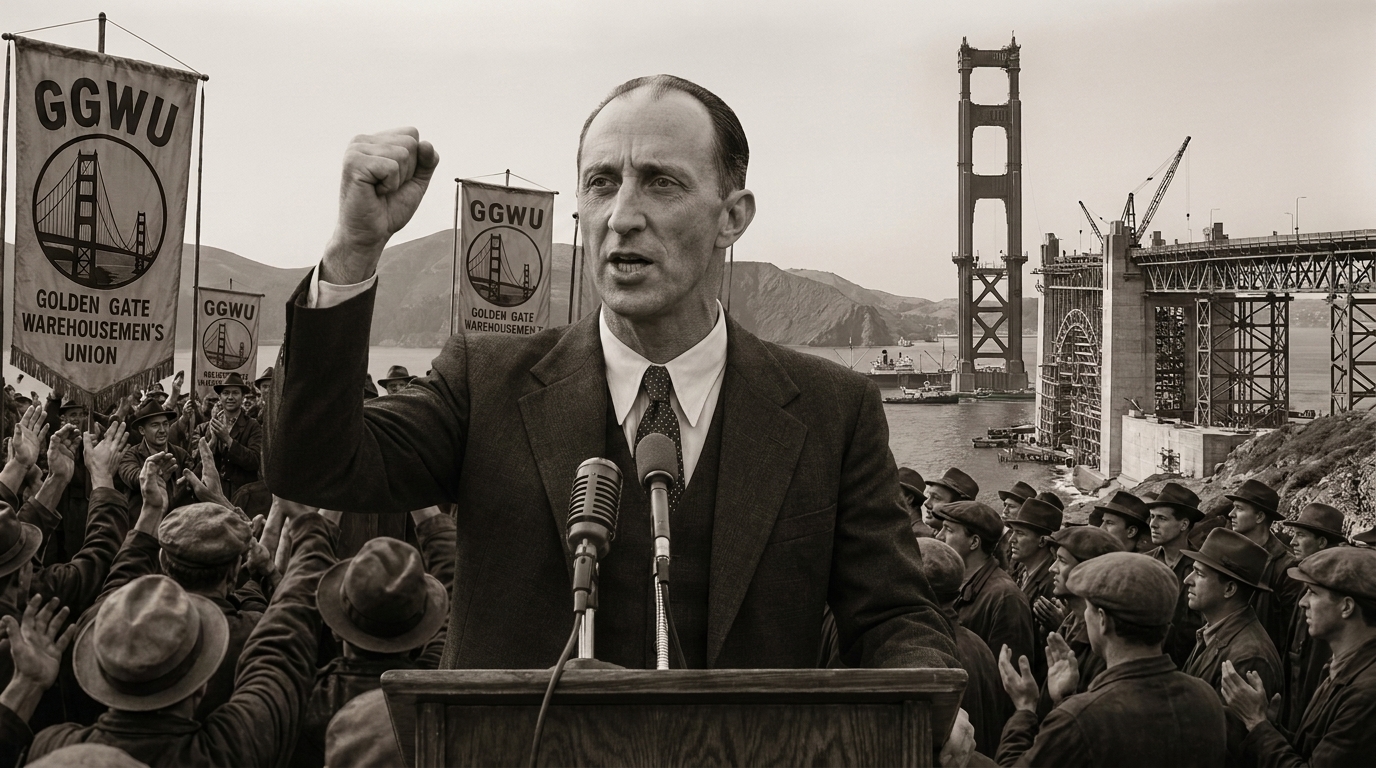
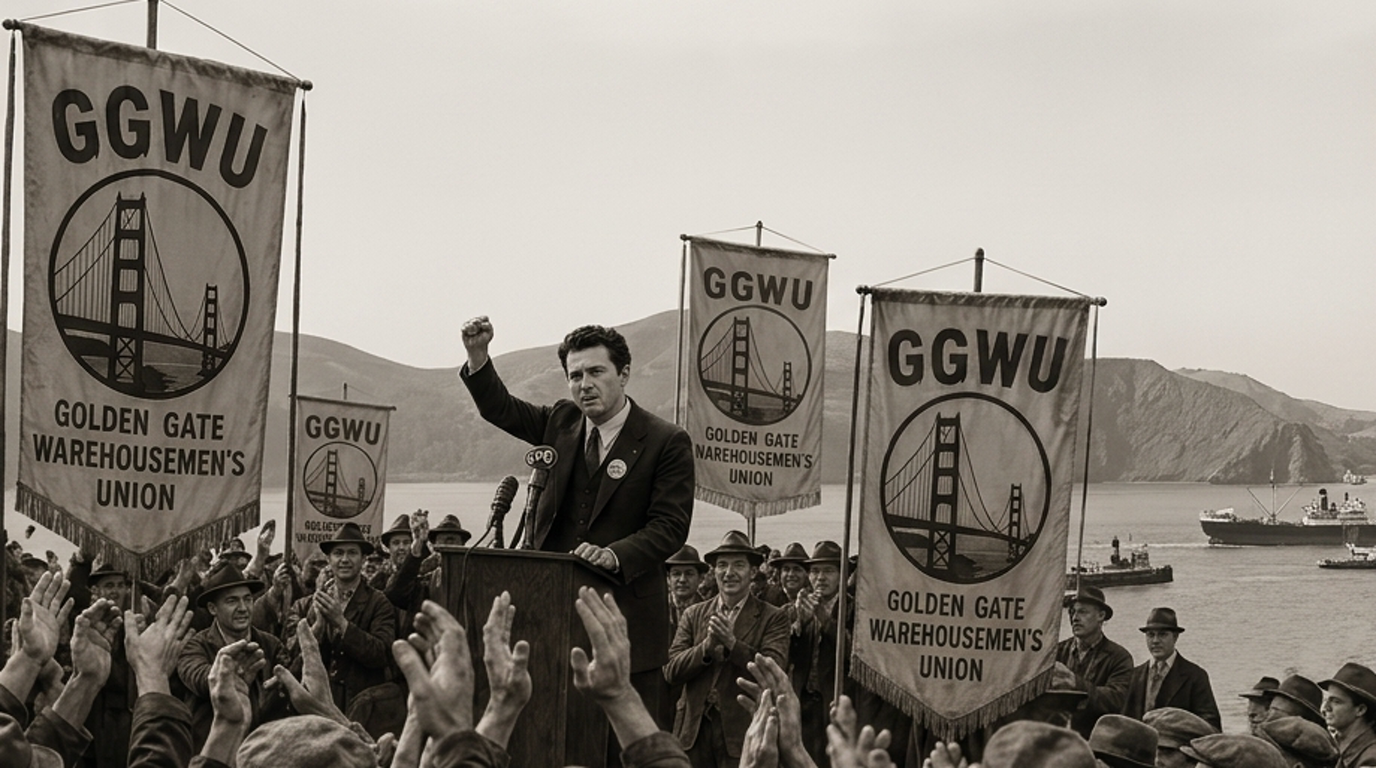
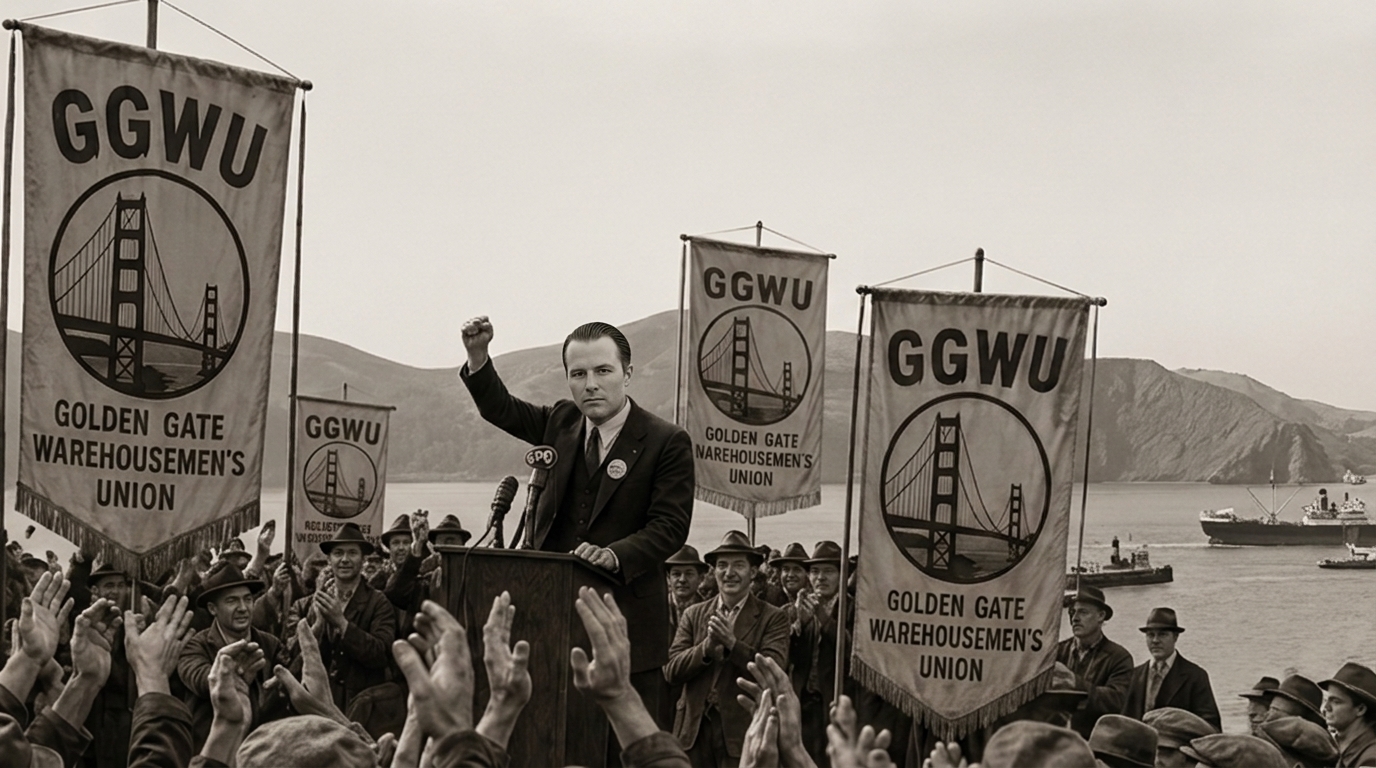
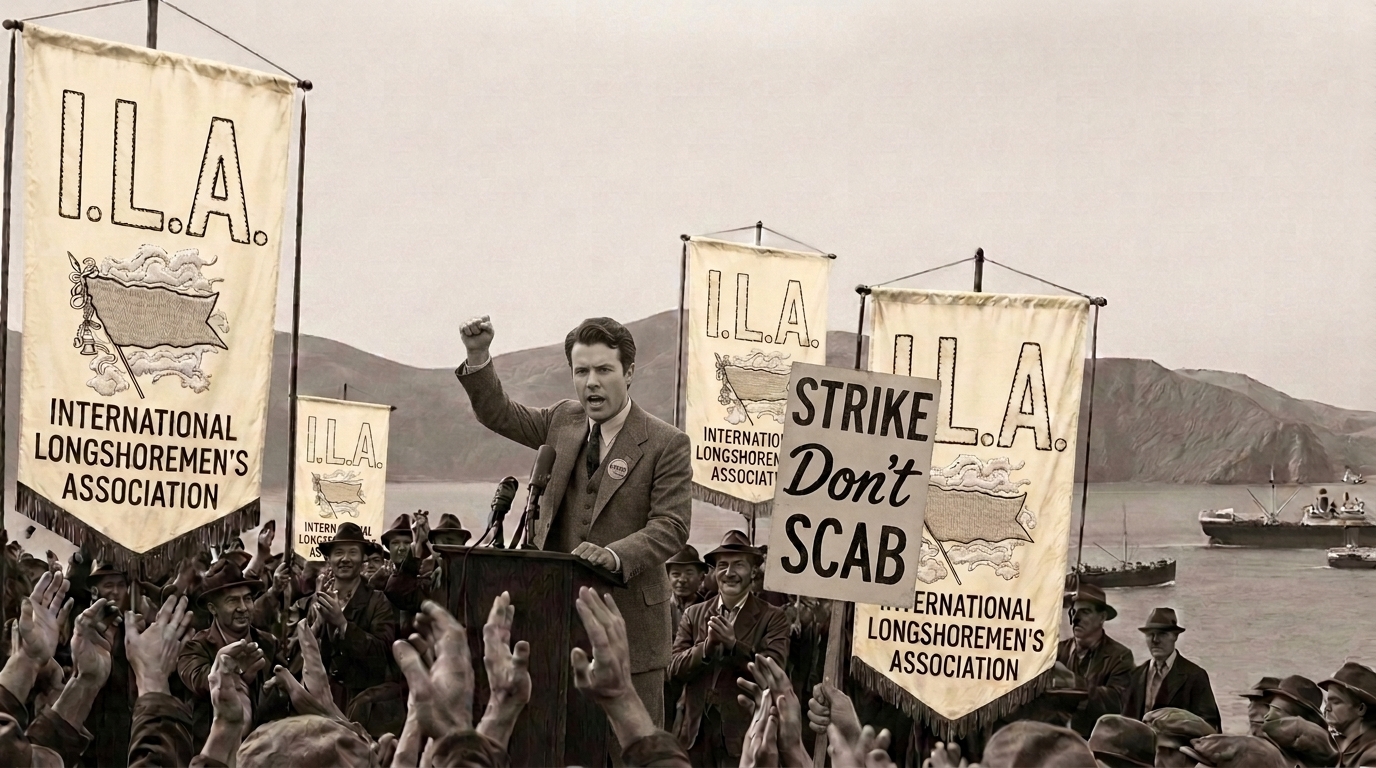
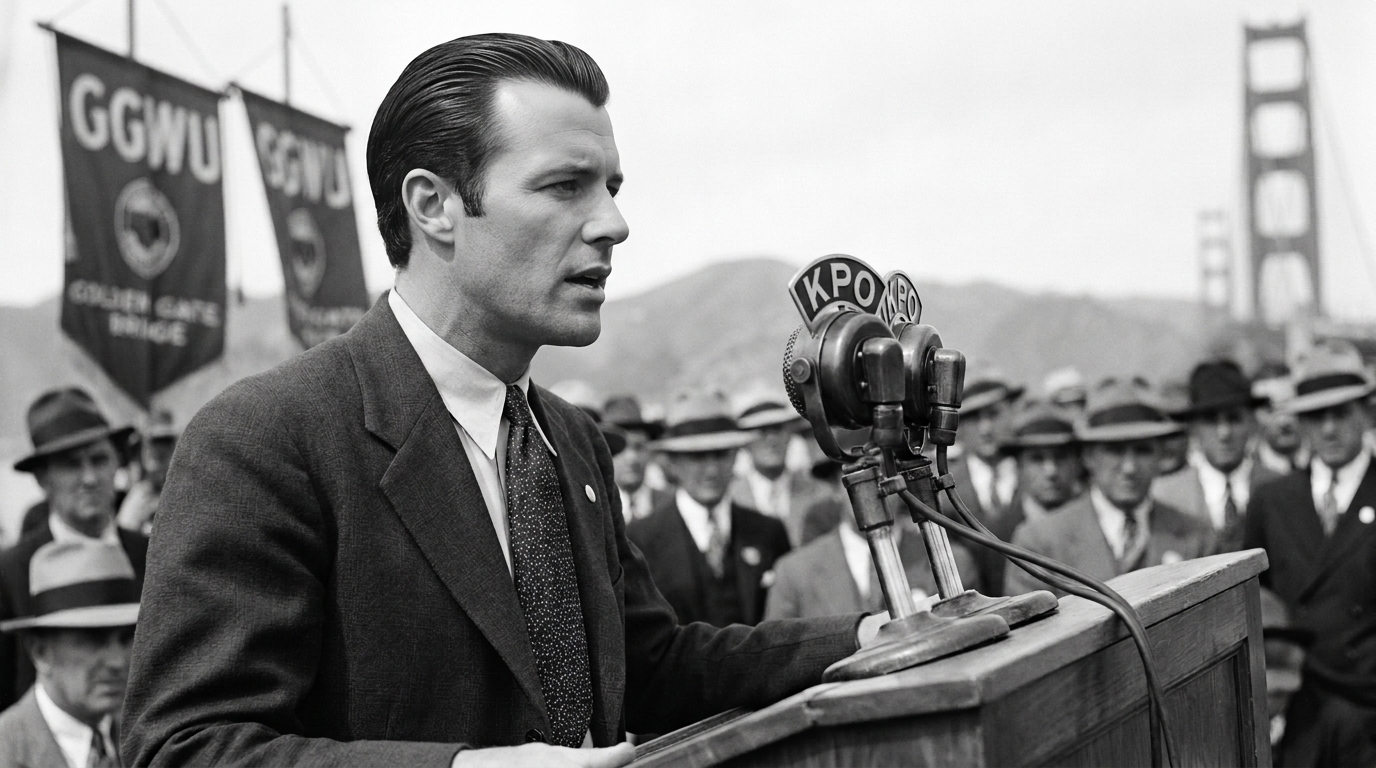
- The speaker (Harry Bridges actor face, slicked-back 1930s pomade hair, mid-30s, defined jaw, three-quarter sightline INTO the rally crowd, mouth open mid-speech, raised right fist) - identical to reference image 2 (v5) which is the speaker source.
- His scale, position, and angle within the frame - identical to reference image 2.
- The wooden podium with the KPO microphone in front of him - identical to reference image 2.
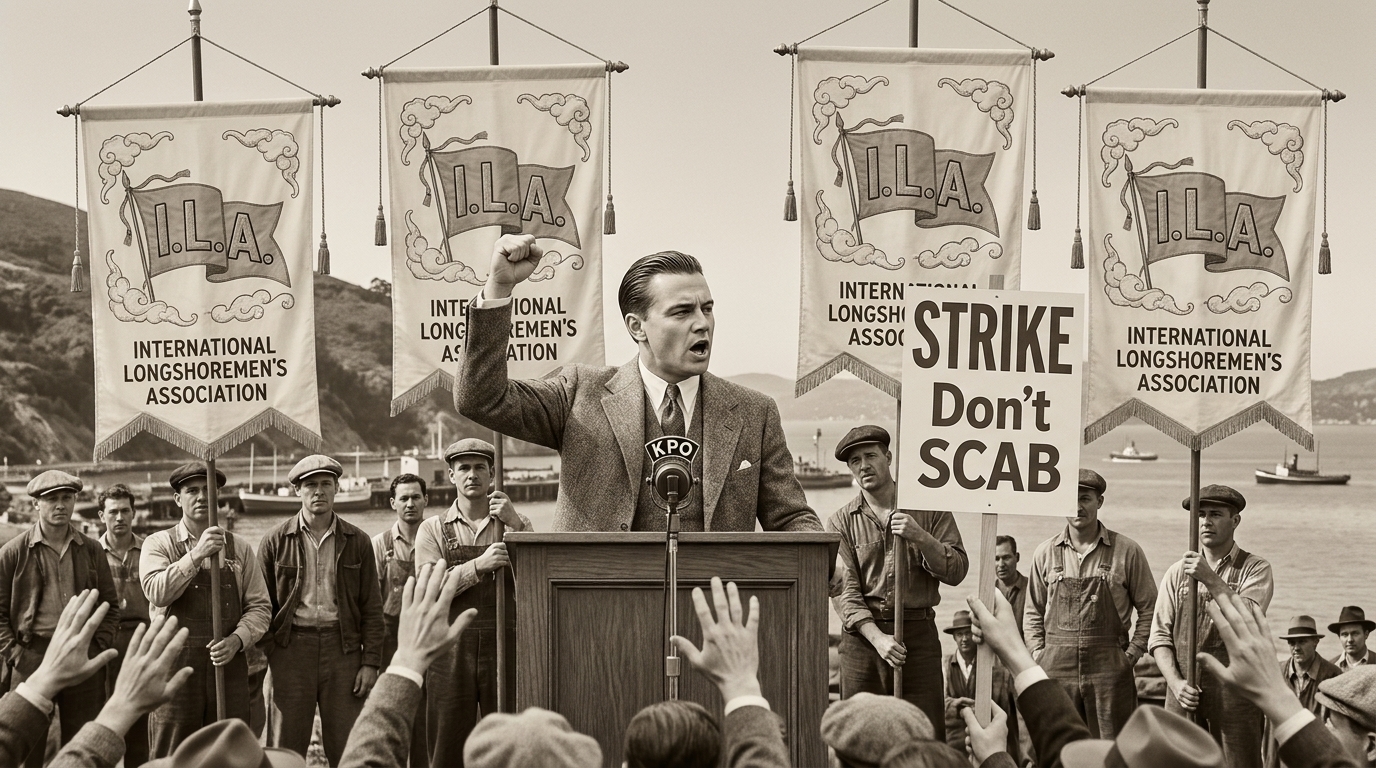
- The cream/ivory cloth ILA banners with dark stitched "I.L.A." block letters at the top, embroidered BLANK ribbon-flag motif (with cloud scrollwork, pole, tassels) in the center, and stitched "INTERNATIONAL LONGSHOREMEN'S ASSOCIATION" text along the bottom - identical to reference image 3 (v7) which is the frame source.
- The single large STRIKE / Don't / SCAB placard in the center-right of the frame (one card, three lines stacked: STRIKE block, Don't cursive, SCAB block) - identical to reference image 3.
- The rally crowd, raised hands at the bottom edge, the workers around the speaker - identical to reference image 3.
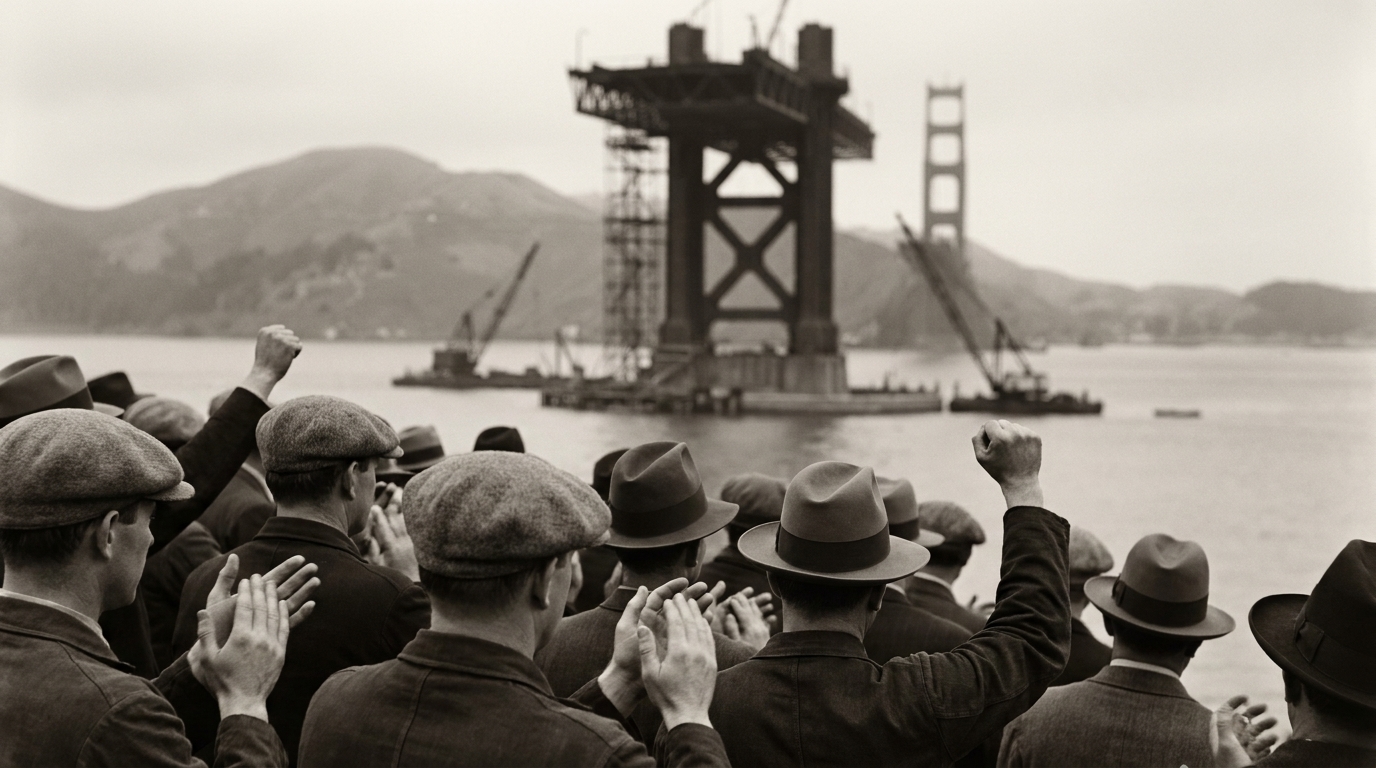
- The hillside, the bay, the boats, the absence of any real Golden Gate Bridge construction - identical to reference image 3.
- The warm sepia / silver-brown photographic tonality with the cream banner cloth as the lightest element - identical to reference image 3.
YOUR ONLY TASK - SMOOTH THE SEAM:
Reference image 1 has a soft feathered alpha edge running roughly around the speaker silhouette where the two source images were composited. Smooth this seam. Re-photograph the whole frame as if it were one continuous 1933 press photo: matching lighting direction, matching sepia tonality, matching grain (or lack of grain, since this is a clean archival still), matching depth of field. The result must read as ONE photograph taken in one moment, not two photographs blended.
REFERENCE IMAGE 2 (v5) AND REFERENCE IMAGE 3 (v7) EXIST ONLY AS AUTHORITATIVE SOURCES for the speaker (ref 2) and the frame (ref 3) respectively, in case the composite is ambiguous on any detail. Do NOT re-imagine, do NOT recompose, do NOT change the speaker's identity, do NOT change the banner artwork, do NOT change the placard, do NOT change the crowd or background.
STRICT DO-NOT LIST:
- Do NOT add or remove any element relative to reference image 1.
- Do NOT change the speaker's face, hair, head size, sightline, fist, or podium.
- Do NOT add any additional placards.
- Do NOT split STRIKE / Don't / SCAB across multiple cards (only the one combined card in the composite).
- Do NOT reintroduce I.L.A. text inside the embroidered ribbon-flag motif on the banners.
- Do NOT reintroduce real bridge construction.
- Do NOT shift the speaker's position or scale relative to reference image 1.
STYLE:
Clean archival 1933 photographic still, period contrast and lens character. Uniform warm sepia / silver-brown tonality with the cream banner cloth as the lightest element. NO film grain, NO dust, NO scratches, NO vignette, NO gate weave, NO emulsion damage. Sharp documentary press-photo look. One continuous photograph, no composite seam visible.
Video prompt (Wan 2.2 / I2V)
Locked-off tighter rally crop with no real bridge construction visible. The labor-union speaker remains on the wooden podium in the mid-ground/left-center, not pushed into the foreground, addressing a crowd that clearly faces him. Preserve the approved vertical ILA banners (cream cloth with stitched "I.L.A." block letters at top, embroidered blank ribbon-flag motif in the center, "INTERNATIONAL LONGSHOREMEN'S ASSOCIATION" stitched at the bottom) from the keyframe; add no new banners. Preserve the single hand-painted STRIKE / Don't / SCAB placard in the crowd. The speaker uses the storyboard identity composite: actor facial features from harry-bridges-face plus slicked-back 1930s hair from harry-bridges-hair.
SPEAKER MOTION: urgent mouth movement in mid-speech, small head turns toward different sections of the crowd, one sharp right-hand gesture from the podium mid-clip. He never looks straight at camera.
CROWD MOTION (beat-by-beat over the 8-second clip, all asynchronous — every worker is a different individual on his own timing, not synchronized):
Beat 1 (0 to ~2s) — APPLAUSE. Most workers in the front and middle of the crowd clap their hands together. Clapping is REAL: hands fully meet at chest or face height, palms strike, then separate again to about 18 inches apart, then meet again. Different workers clap at slightly different rates and out-of-phase with each other. Some clap fast, some slow, some pause between claps. No "half clap" where hands hover near each other — every clap is a full meet-and-separate cycle.
Beat 2 (~2 to ~4s) — HANDS DROP. A noticeable subset of workers (maybe a third of them) stops clapping and lowers their hands — some drop to their sides, some clasp in front of the waist, a few rest a hand on a shoulder of the man next to them. The drop is staggered: each worker decides on his own moment to stop. The remaining workers continue clapping at their own rhythm. A few workers turn their heads to glance at a neighbor.
Beat 3 (~4 to ~6s) — FISTS UP. A different subset of workers (some of the ones who just lowered their hands, plus a few new ones) raises a right or left fist into the air in a sharp punching motion and holds it. Other workers raise their hand to RESUME clapping after having lowered it. So we now see a heterogeneous crowd: raised fists, hands clapping, hands lowered — all simultaneously.
Beat 4 (~6 to 8s) — MIXED STATE CONTINUES. Several workers who had fists up lower them again; a few workers who had been clapping switch to a raised fist; some workers turn their bodies slightly or shift weight foot to foot. Throughout this beat the mix of clapping / fist-up / hands-down keeps evolving — no worker stays in one pose for the entire beat, and no two workers are in lockstep.
GLOBAL CROWD RULES: every worker is doing his own thing. Avoid any synchronized clap. Avoid every worker doing the same motion in the same frame. Avoid a "Mexican wave" pattern. Hats and shoulders should also have small natural micro-motion (slight head bobs, hat brims tilting). At any given frame, count visible workers in three groups — clapping, fists up, hands lowered — and ensure all three groups have visible members from beat 2 onward.
Style: orthochromatic black-and-white tonality with elevated silver-halide grain — coarse, organic, frame-to-frame grain crawl with no temporal denoising. Nitrate-stock contrast curve: crushed blacks, blown highlights, compressed midtones, slight sepia/silver tint baked in rather than colorized.
Cinch marks and emulsion scratches: thin vertical tramlines flicking in and out across a few frames at a time, paired with intermittent base-side scratches. Random splice jumps every few seconds. Airborne dust, hair, and negative debris drifting through the gate — black specks on dark areas, white specks on light. Light fungus blooms and edge mold on frame extremities.
Mechanical instability of a hand-cranked Bell & Howell / Akeley camera: low-frequency horizontal and vertical gate weave plus subtle perforation hop. Density pumping / bipack flicker from inconsistent shutter exposure — irregular luminance breathing every 6 to 12 frames. Occasional single-frame overexposure pops.
Undercranked 16 to 18 fps source conformed to a 24 fps timeline via frame doubling / pulldown, producing the signature jerky, slightly accelerated motion of theatrically projected silent footage. No motion blur smoothing.
Period-accurate 1933 clean BLACK-AND-WHITE documentary press photograph, WIDE LANDSCAPE 16:9. Clean archival still only: NO film grain, NO dust, NO scratches, NO vignette, NO gate weave, NO emulsion damage. Sharp documentary press-photo focus and contrast.
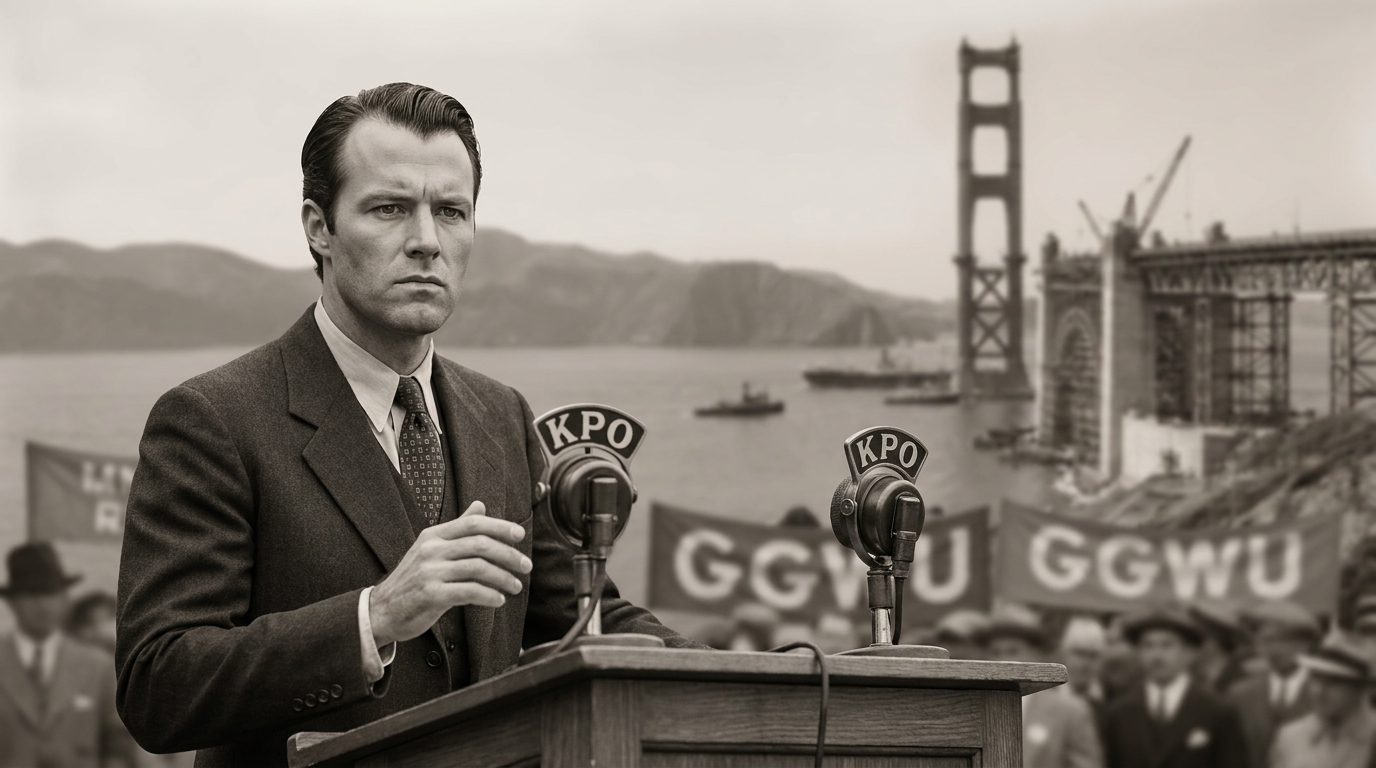
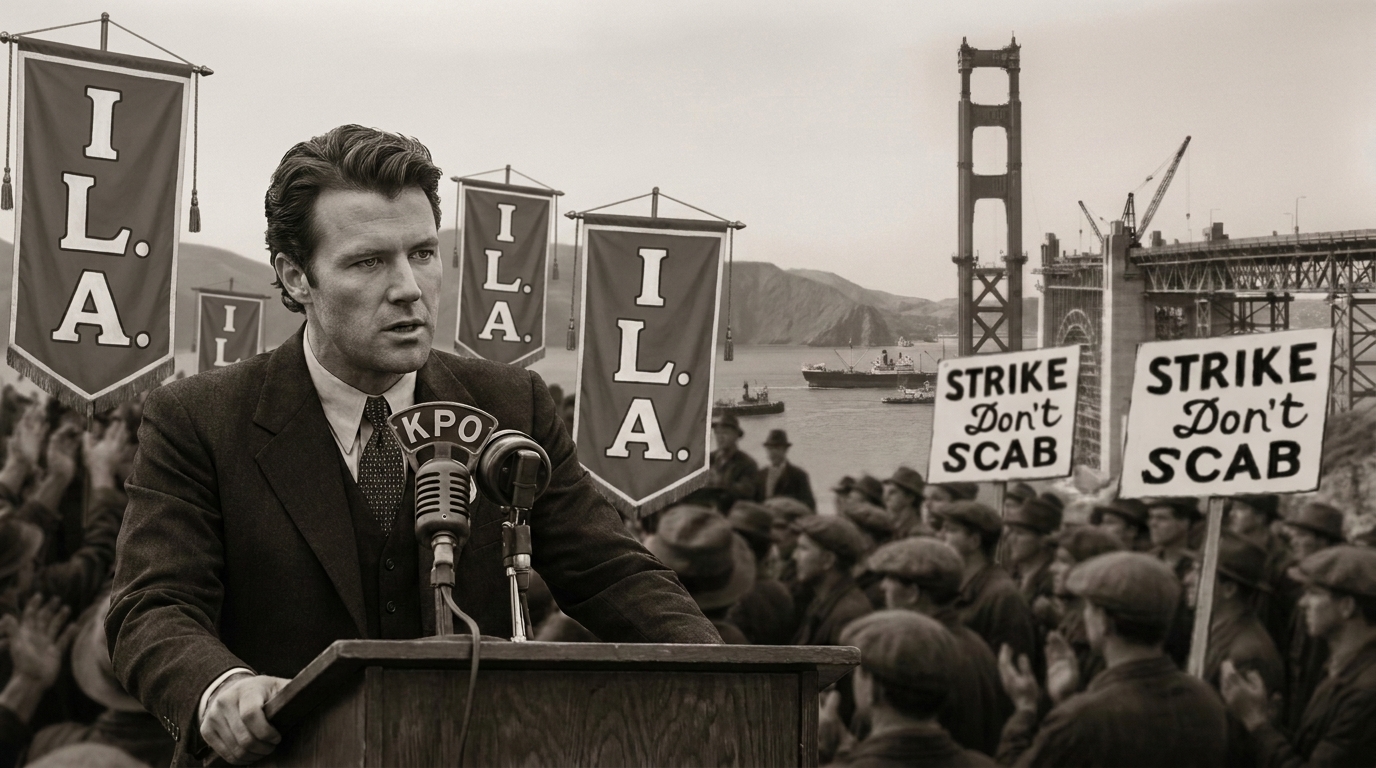
Refine reference image 1 with TWO surgical changes. The CAMERA, CROP, FRAMING, SCALE, ANGLE, AND COMPOSITION ARE ABSOLUTELY LOCKED.
REFERENCE IMAGE 1 IS THE COMPOSITION MASTER - LOCK THESE EXACTLY:
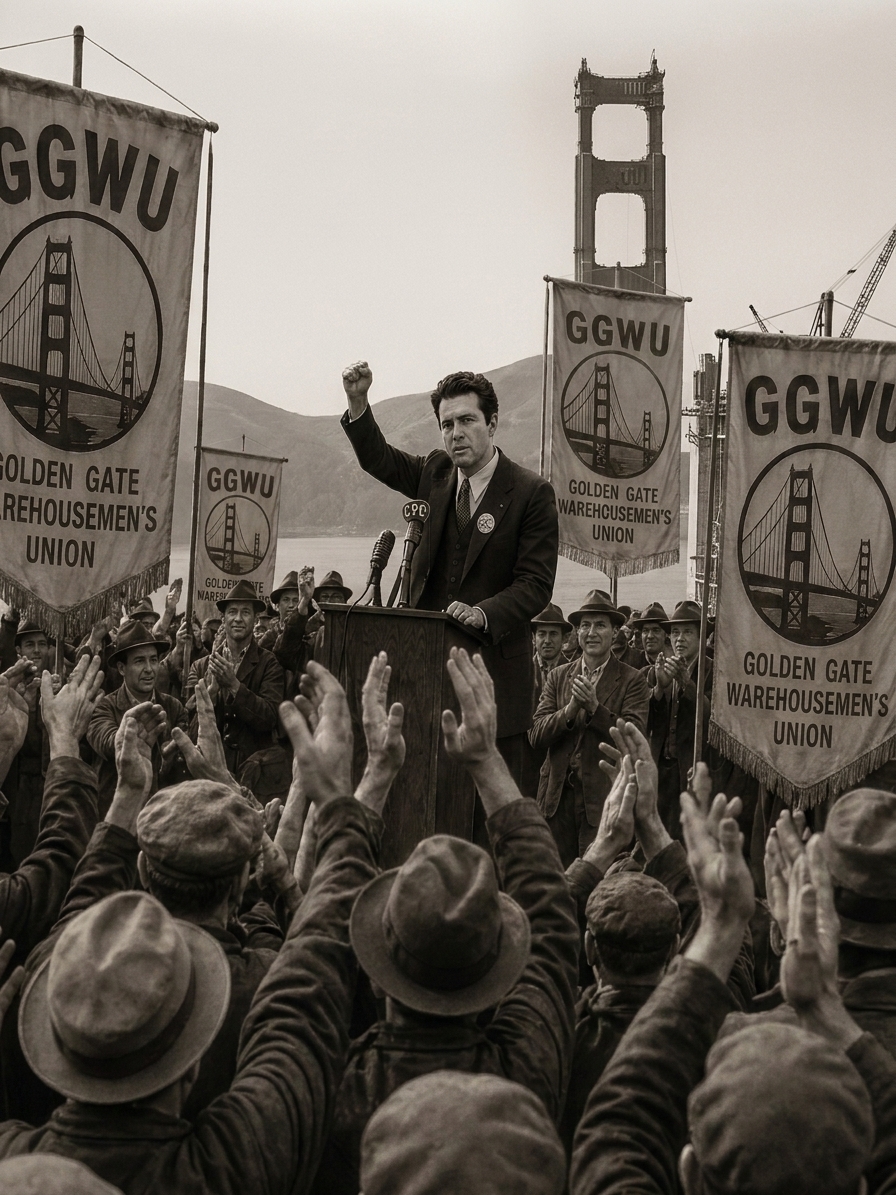
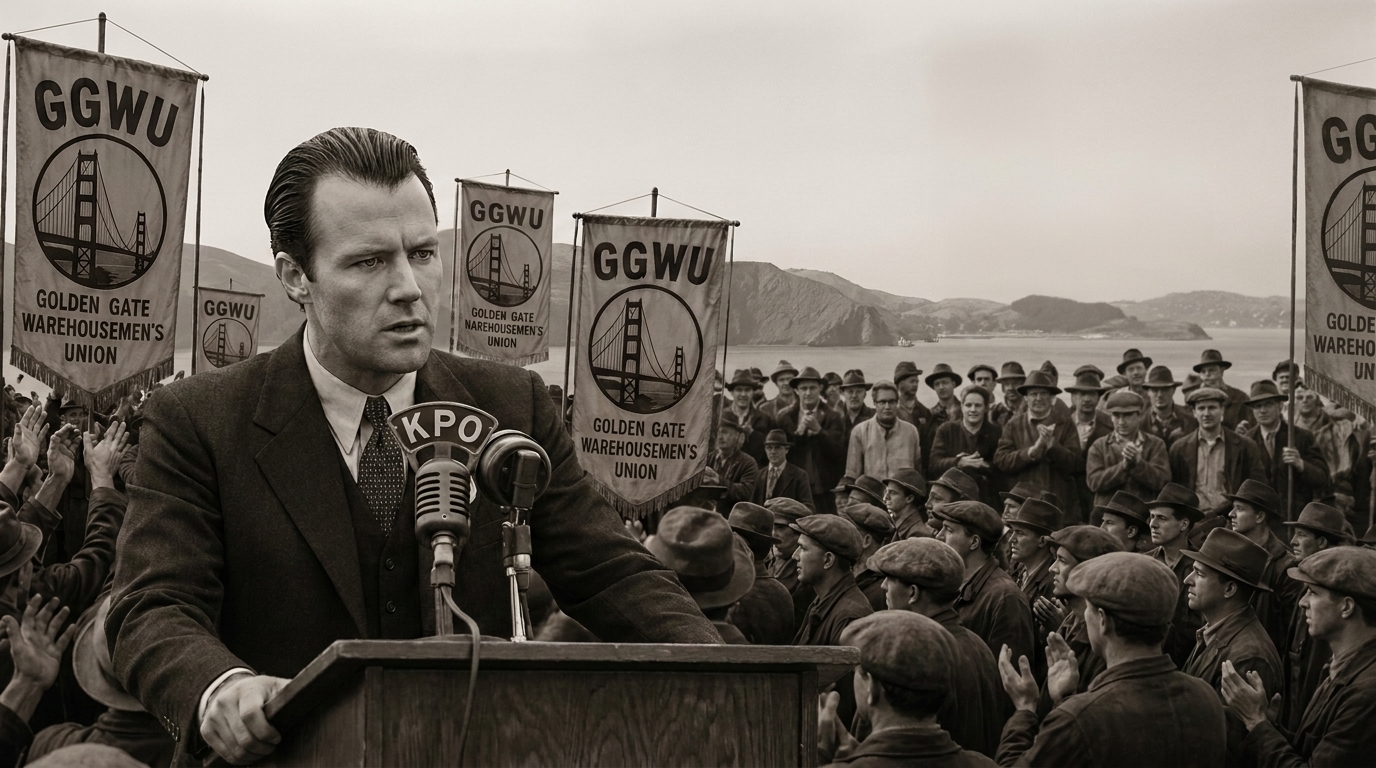
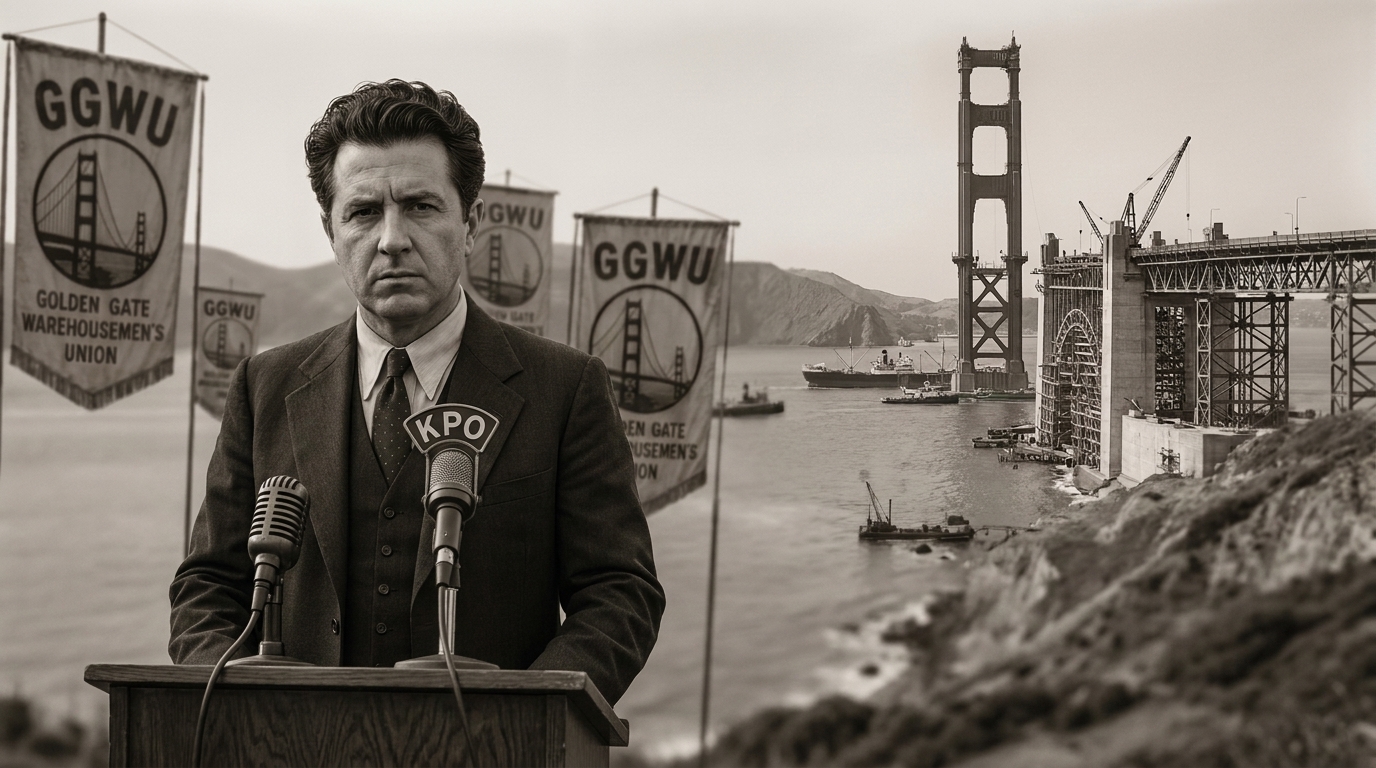
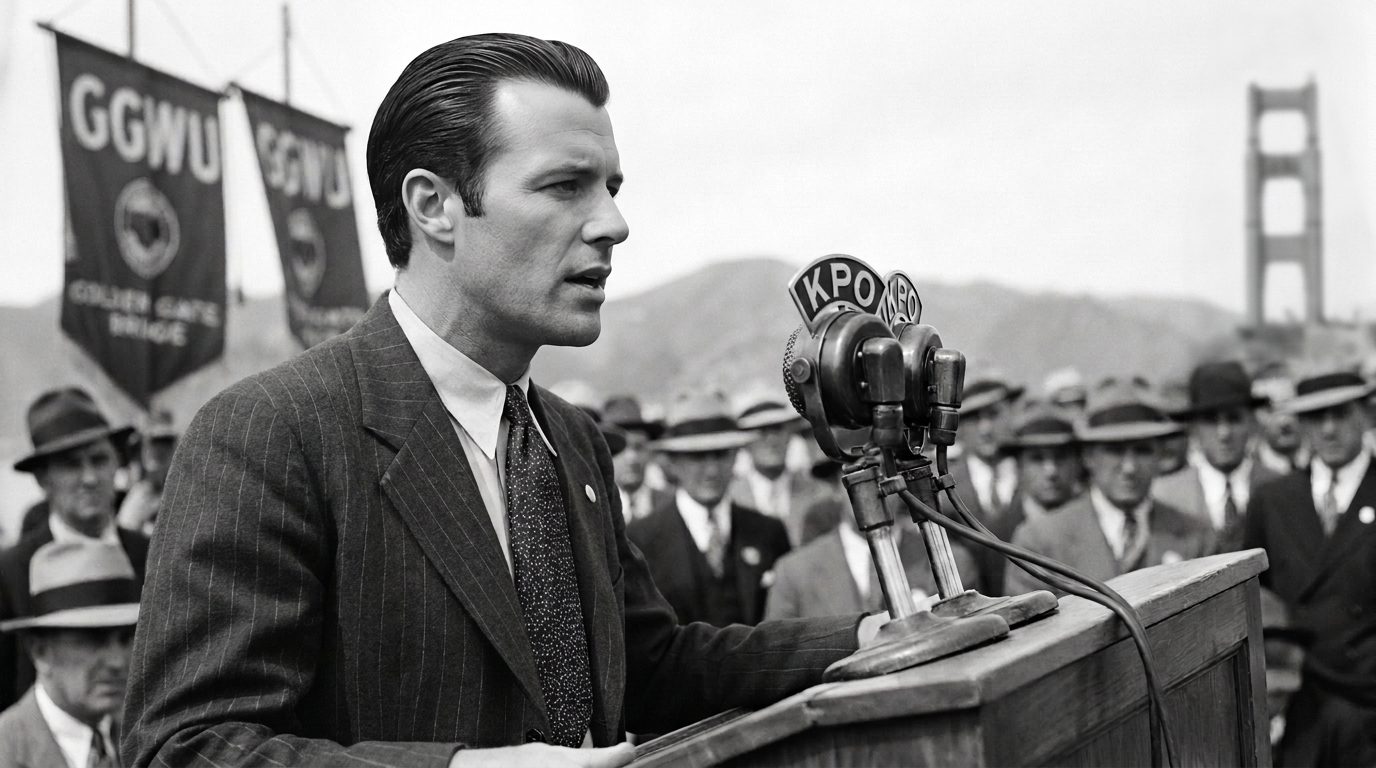
- This is a TIGHT three-quarter profile portrait of the speaker. The speaker fills the left and center of the frame. The camera is close. Do NOT pull the camera back. Do NOT recompose into a wide rally shot. Do NOT shift the camera position. Do NOT shrink the speaker in the frame. This is NOT a rally wide shot.
- The speaker's head occupies a large portion of the left/center of the frame.
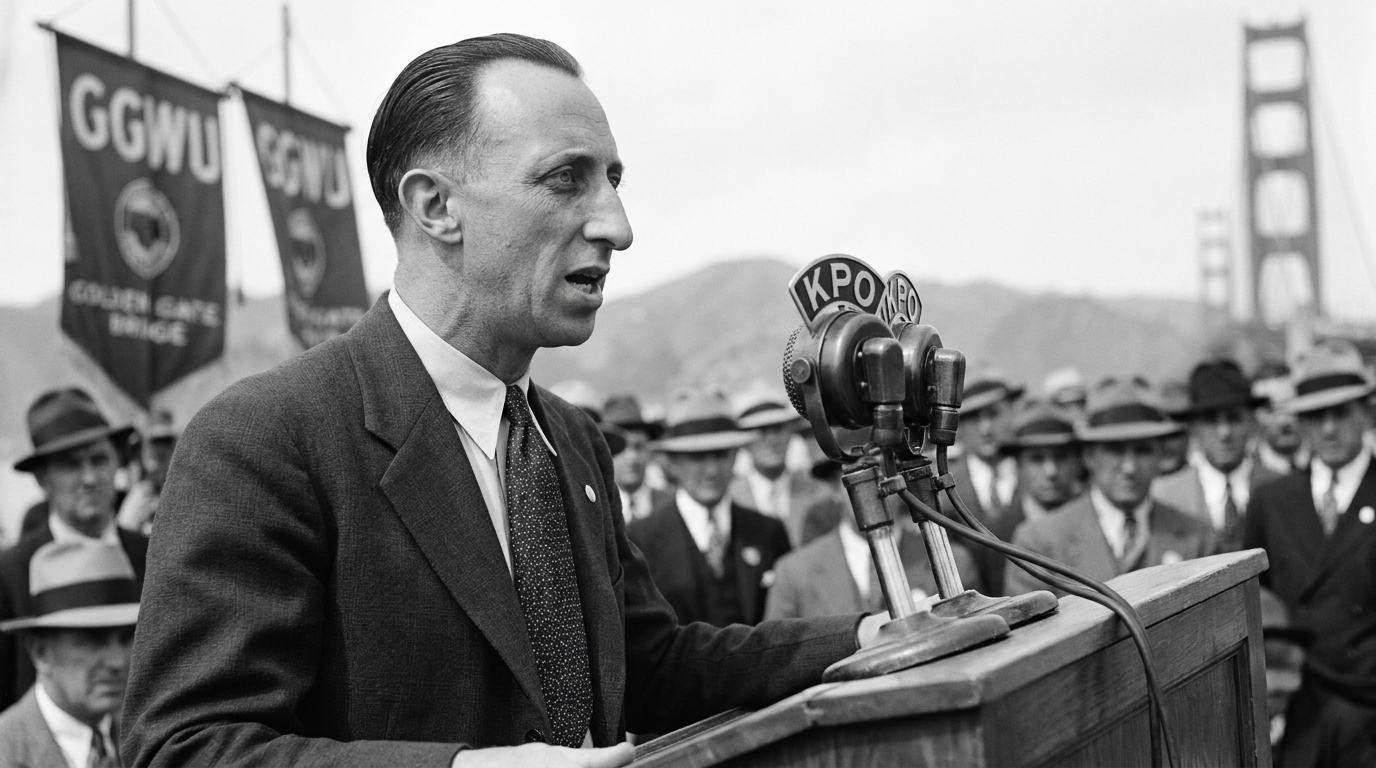
- The speaker himself: Harry Bridges actor face in profile/three-quarter to camera, slicked-back 1930s hair, suit, polka-dot tie, lapel button, mouth open mid-speech.
- The wooden podium with the dual KPO microphones in front of him (right side of frame).
- The crowd of dockworkers behind him, partially visible in the middle-distance background.
- The single unfinished Golden Gate Bridge tower visible in the upper right corner of the frame. ONE tower only - no second tower, no completed span.
- The hillside and bay visible behind.
- The clean BLACK-AND-WHITE press photo tonality. This shot is B&W, not sepia. Keep it B&W.
REFERENCE IMAGE 2 (Harry Bridges face) and REFERENCE IMAGE 3 (Harry Bridges hair) are the speaker identity locks - the speaker in reference image 1 already matches these.
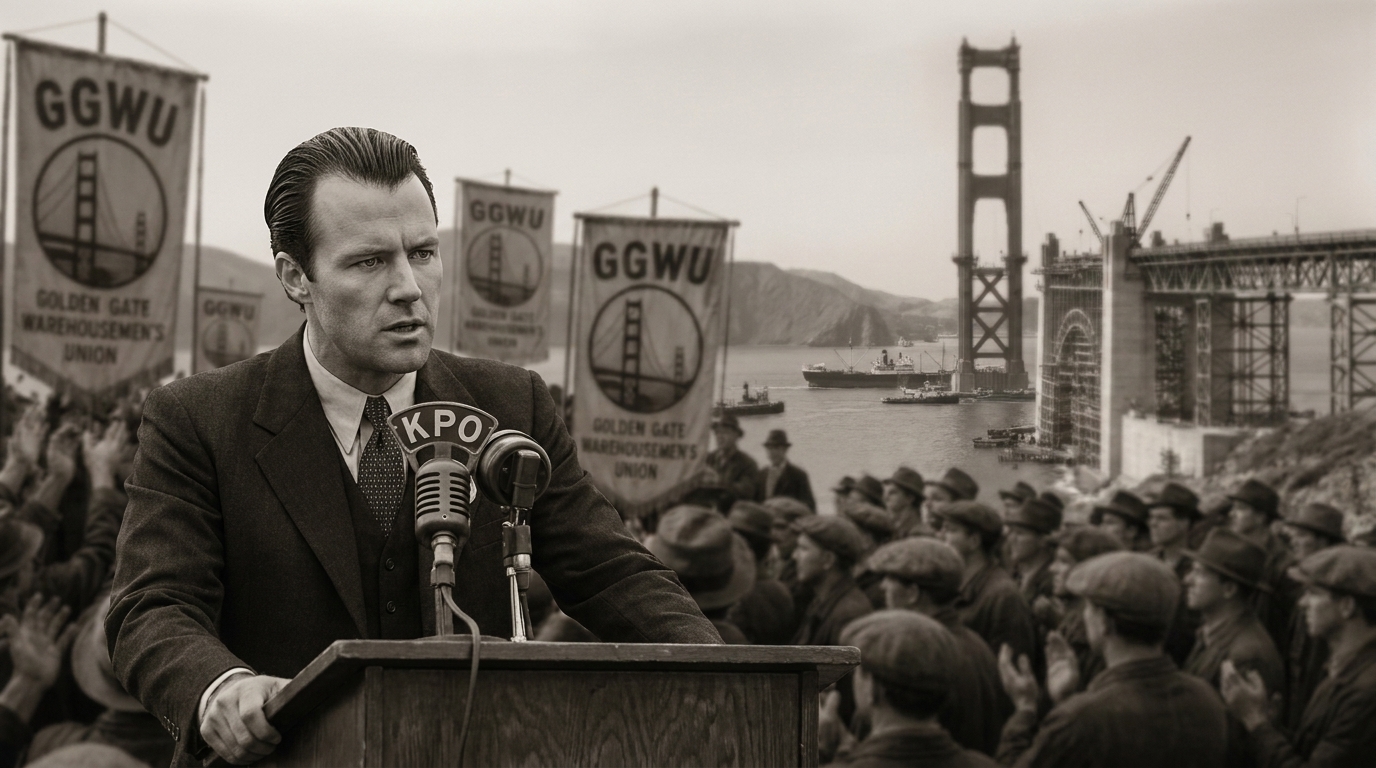
CHANGE 1 - REPLACE THE GGWU BANNERS WITH ILA BANNERS (same positions, same shape):
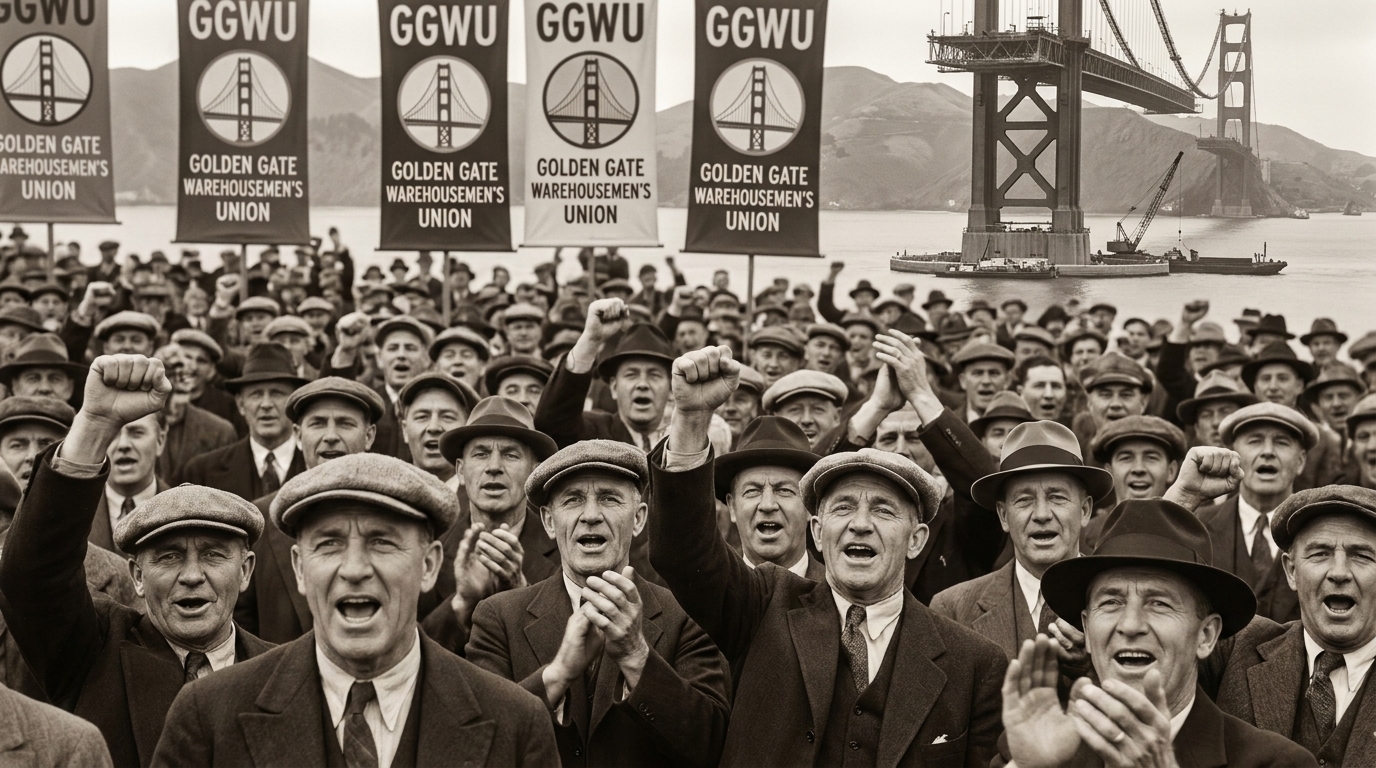
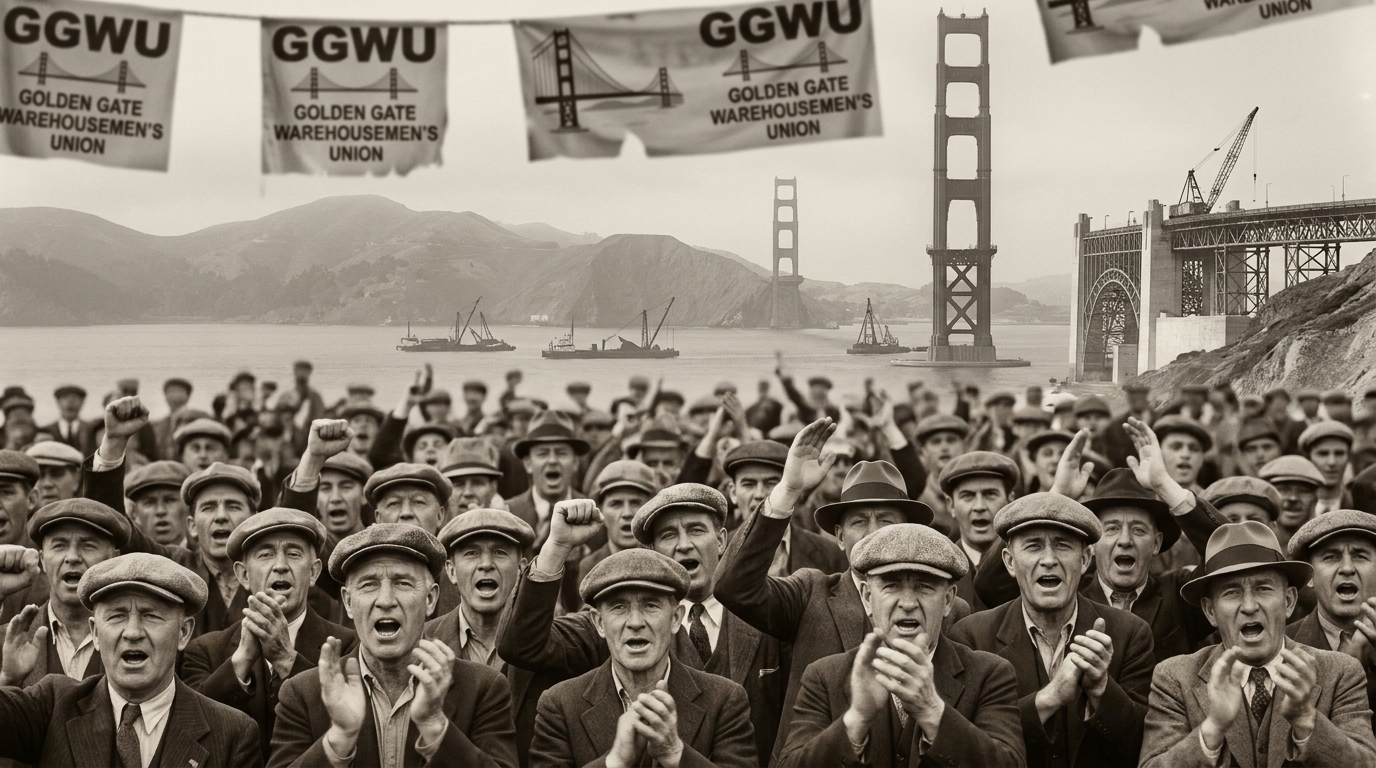
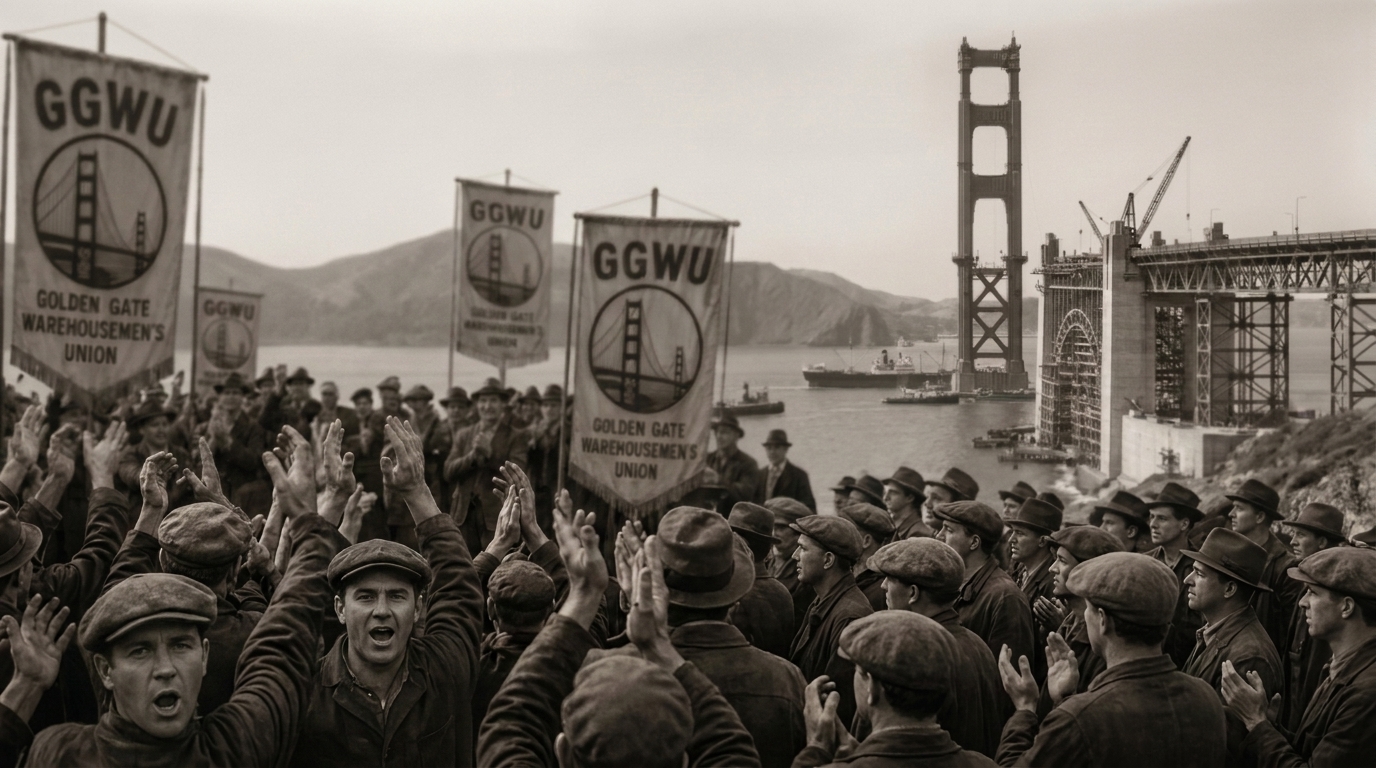
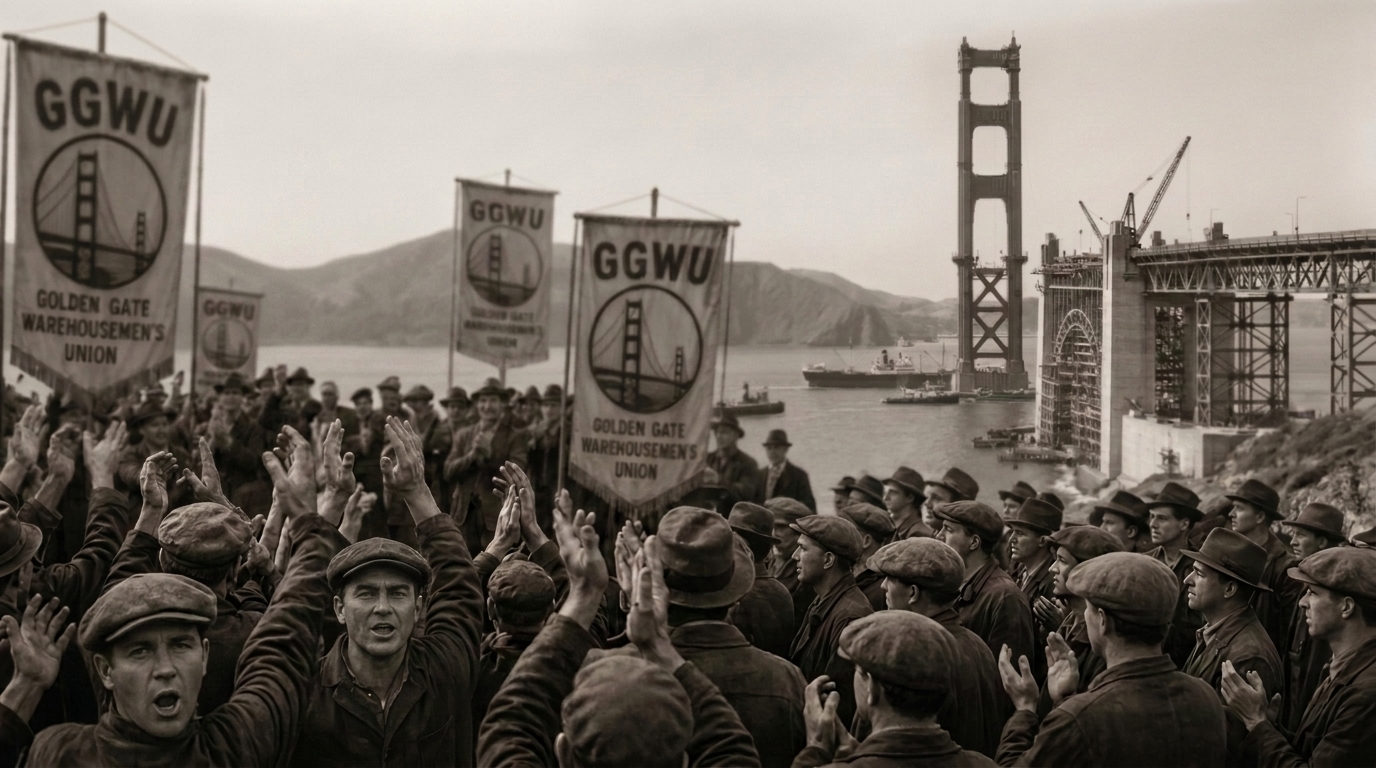
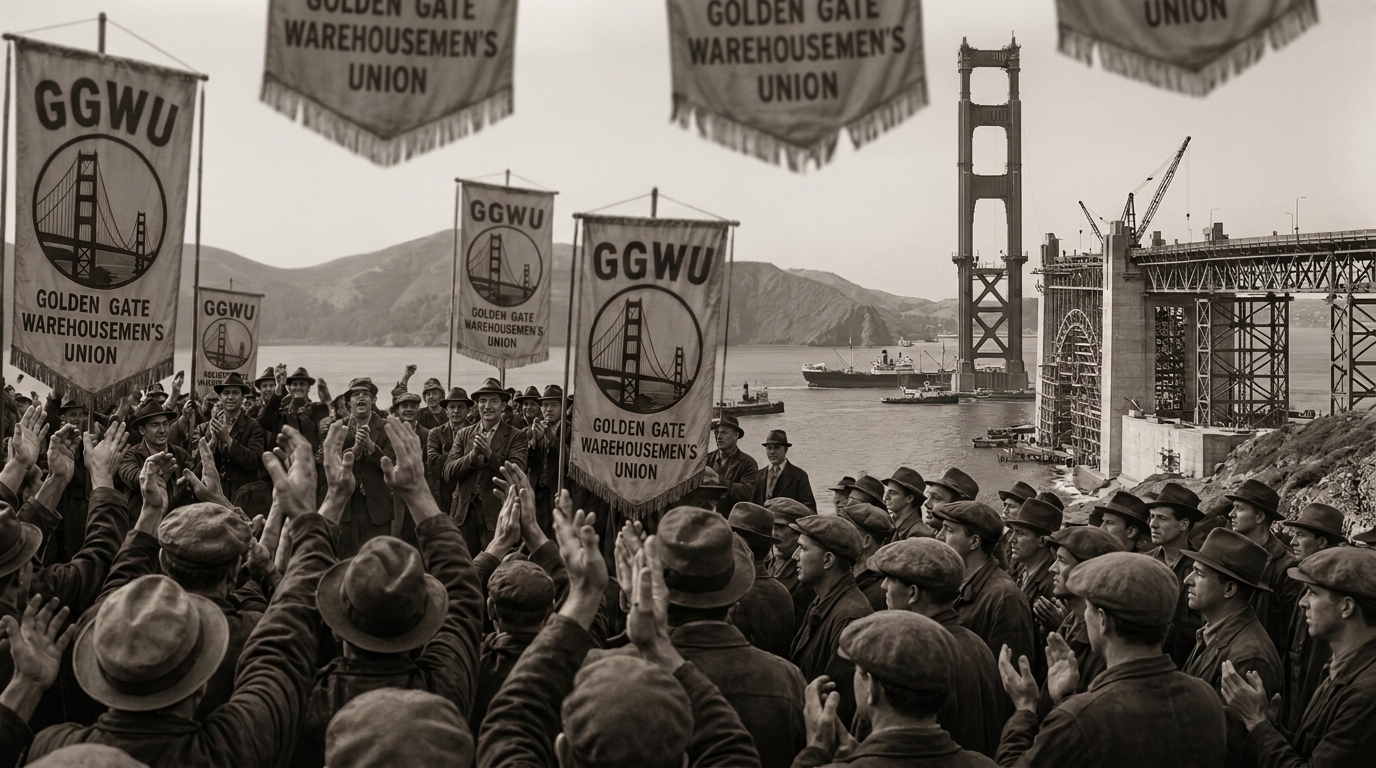
Reference image 1 has TWO visible GGWU banners on the left behind the speaker. Each shows the circular Golden Gate Bridge logo and "GGWU" / "GOLDEN GATE WAREHOUSEMEN'S UNION" stitched text on a dark cloth.
Replace these two banners 1:1 in their EXACT same positions, same sizes, same fabric drape, same pole angles. The new banners are LIGHTER cream / ivory cotton cloth (lighter than the original GGWU banners but still period-correct, photographed in B&W as a pale cloth against the surrounding mid-tones). The new artwork on each banner, from top to bottom, is:
- "I.L.A." in tall dark stitched block capitals at the top
- directly below, a small embroidered ribbon-flag motif - a short stitched fabric ribbon shape with surrounding stitched cloud scrollwork and a tiny stitched flagpole with tassels. The ribbon-flag in this motif is BLANK - no letters inside the flag, no I.L.A. text in the ribbon
- along the lower portion, smaller stitched dark text reading "INTERNATIONAL LONGSHOREMEN'S ASSOCIATION"
All lettering and the small ribbon motif read as EMBROIDERED / STITCHED into the cloth - visible thread texture, slightly raised. NOT painted, NOT printed, NOT a flag pasted on the cloth. Same banner shape, same pole, same hanging tassels.
Remove every "GGWU" / "Golden Gate Warehousemen's Union" word and the circular GG-bridge logo. Do NOT add extra banners. Do NOT change banner positions, sizes, or count.
CHANGE 2 - ADD ONE PARTIAL STRIKE PLACARD IN THE BACKGROUND CROWD:
Add EXACTLY ONE hand-painted picket sign held above shoulders by one worker in the crowd behind/beside the speaker. The placard:
- is a single rectangular piece of plain white card stock or thin plywood, roughly 18 by 24 inches, hand-painted with thick black ink
- shows ALL THREE LINES of the slogan stacked on the SAME face of the SAME single card:
top: "STRIKE" in tall block capitals
middle: "Don't" in quick cursive script
bottom: "SCAB" in tall block capitals
- is positioned in the available space within the crowd behind the speaker, partially visible (the speaker, microphones, podium, and banners all remain fully visible and unblocked)
- is sized so it does NOT dominate the frame and does NOT obscure any of the locked elements
- is held at a slight tilt by one of the workers in the background crowd
Only ONE placard total. Do NOT split "STRIKE", "Don't", or "SCAB" across separate cards.
STRICT DO-NOT LIST:
- Do NOT change the camera angle, crop, framing, scale, or composition.
- Do NOT recompose to a wide rally shot.
- Do NOT pull the camera back.
- Do NOT shrink the speaker.
- Do NOT add more than two banners.
- Do NOT add more than one placard.
- Do NOT split the slogan across cards.
- Do NOT switch from B&W to sepia globally; this is a B&W press photo. Only the banner cloth itself reads as a pale cream value within the B&W palette.
- Do NOT add a second bridge tower.
STYLE:
Clean archival 1933 B&W documentary press photograph, period contrast and lens character, deep depth of field. NO film grain, NO dust, NO scratches, NO vignette, NO gate weave, NO emulsion damage.
Video prompt (Wan 2.2 / I2V)
Locked-off medium close shot from the corrected liked podium-side angle. Preserve the side/front-left three-quarter camera position: Harry Bridges is larger in frame, the podium edge runs diagonally, KPO microphones overlap from the side, and the crowd/banners recede obliquely behind him. The speaker must use the storyboard identity composite: actor facial features from harry-bridges-face plus slicked-back 1930s hair from harry-bridges-hair. Do not use the wrong gaunt 4EPTFF actor. The bridge stays at the same 1933 construction state with exactly one unfinished tower visible, soft and secondary on the right/background side; no second tower or completed span. Use only approved vertical GGWU banners, no new banners or placards. Clean keyframe-matched 1933 documentary motion; archival film artifacts are not decided yet.
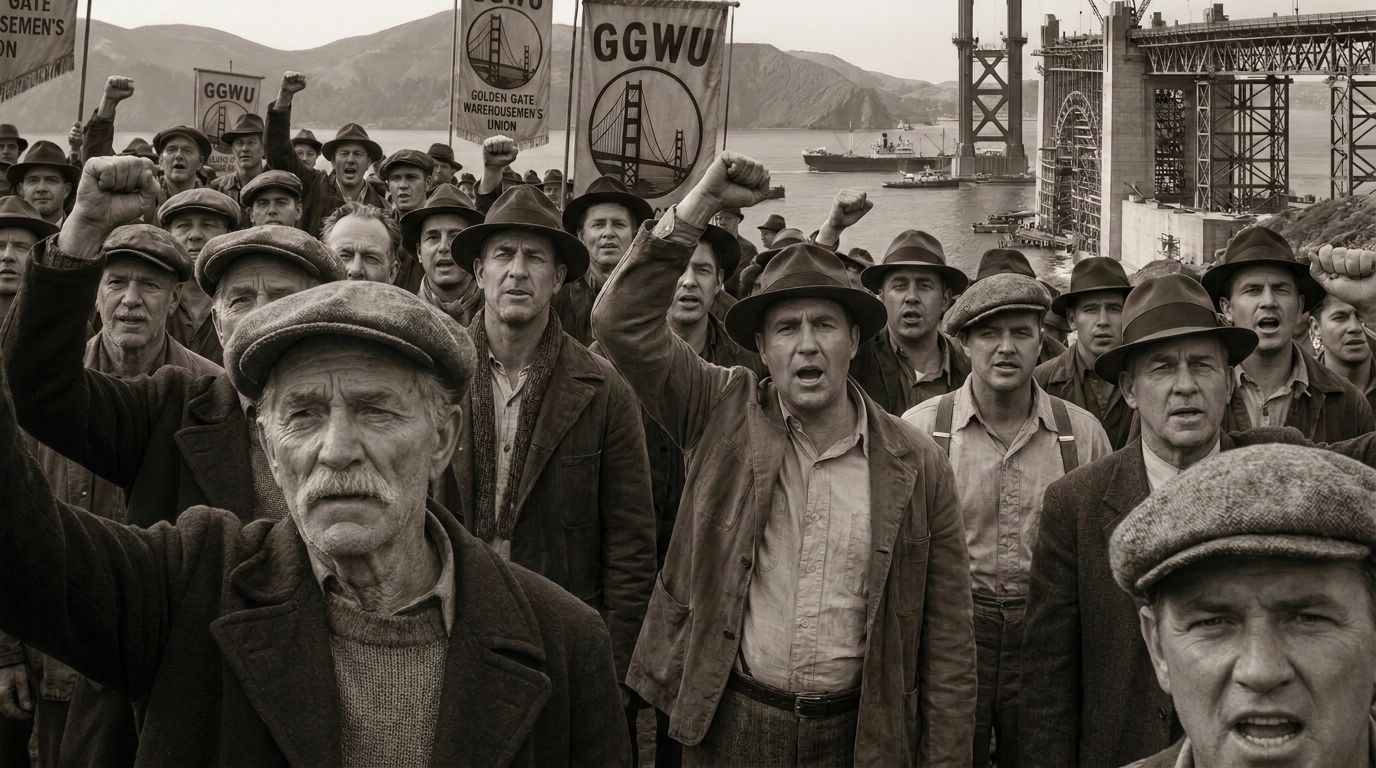
Period-accurate 1933 clean documentary press photograph, WIDE LANDSCAPE 16:9. Clean archival still only: NO film grain, NO dust, NO scratches, NO vignette, NO gate weave, NO emulsion damage.
Refine reference image 1 with TWO surgical changes. Everything else is LOCKED to reference image 1.
REFERENCE IMAGE 1 IS THE COMPOSITION MASTER. LOCK EXACTLY:
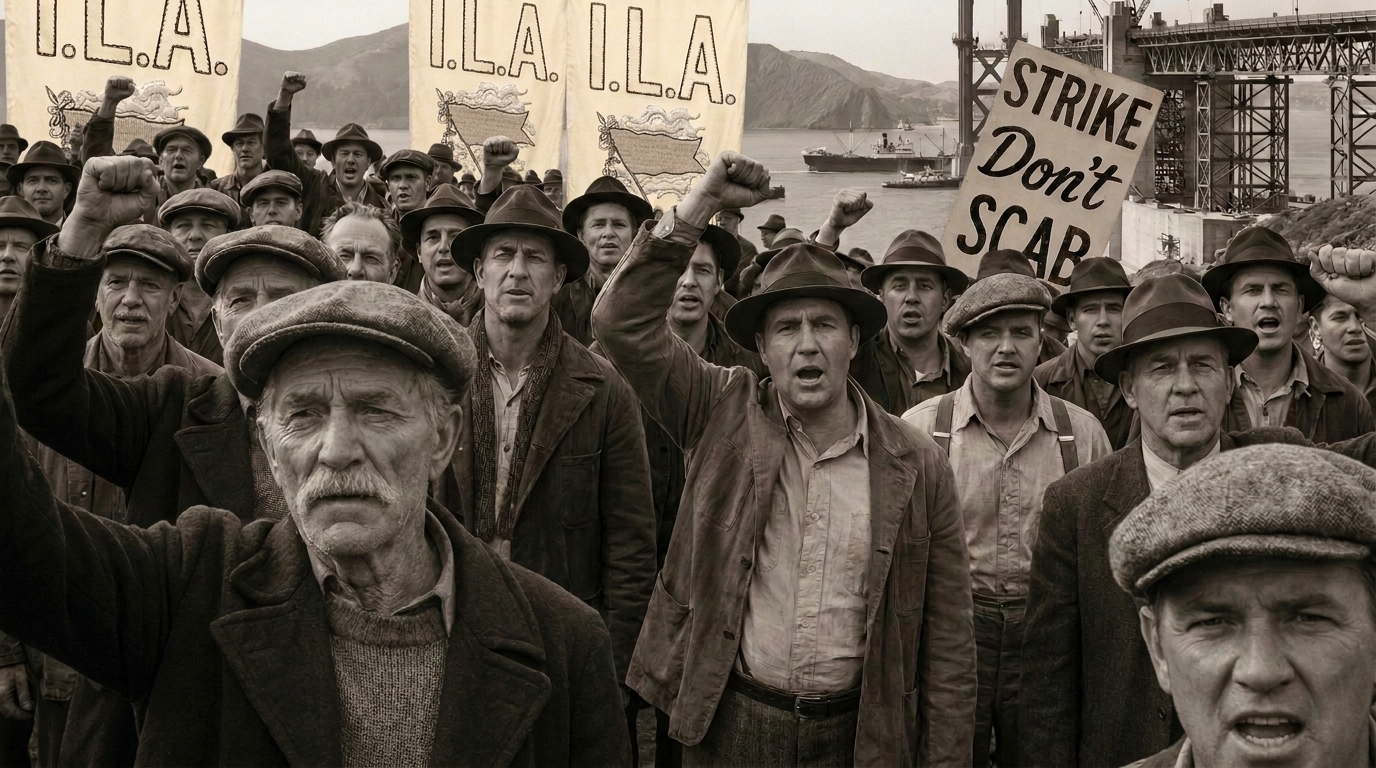
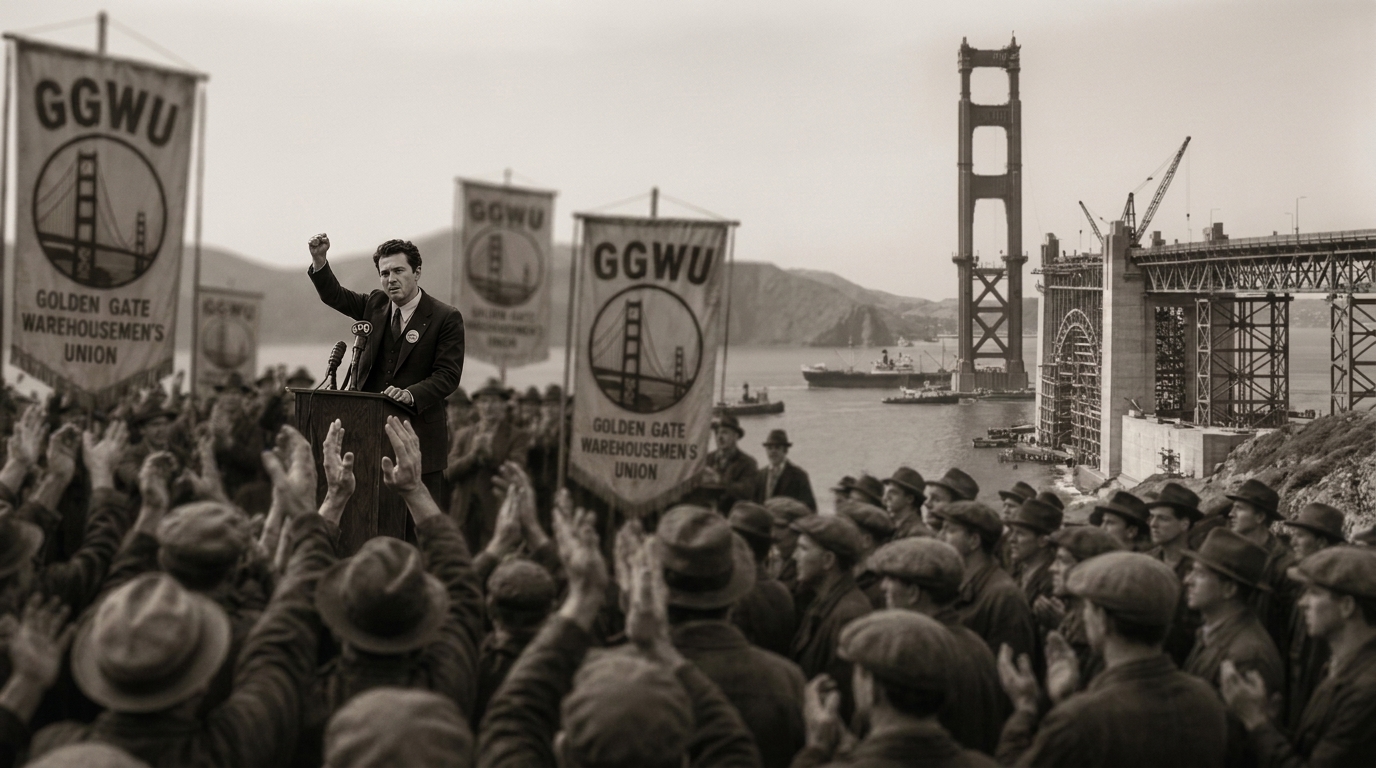
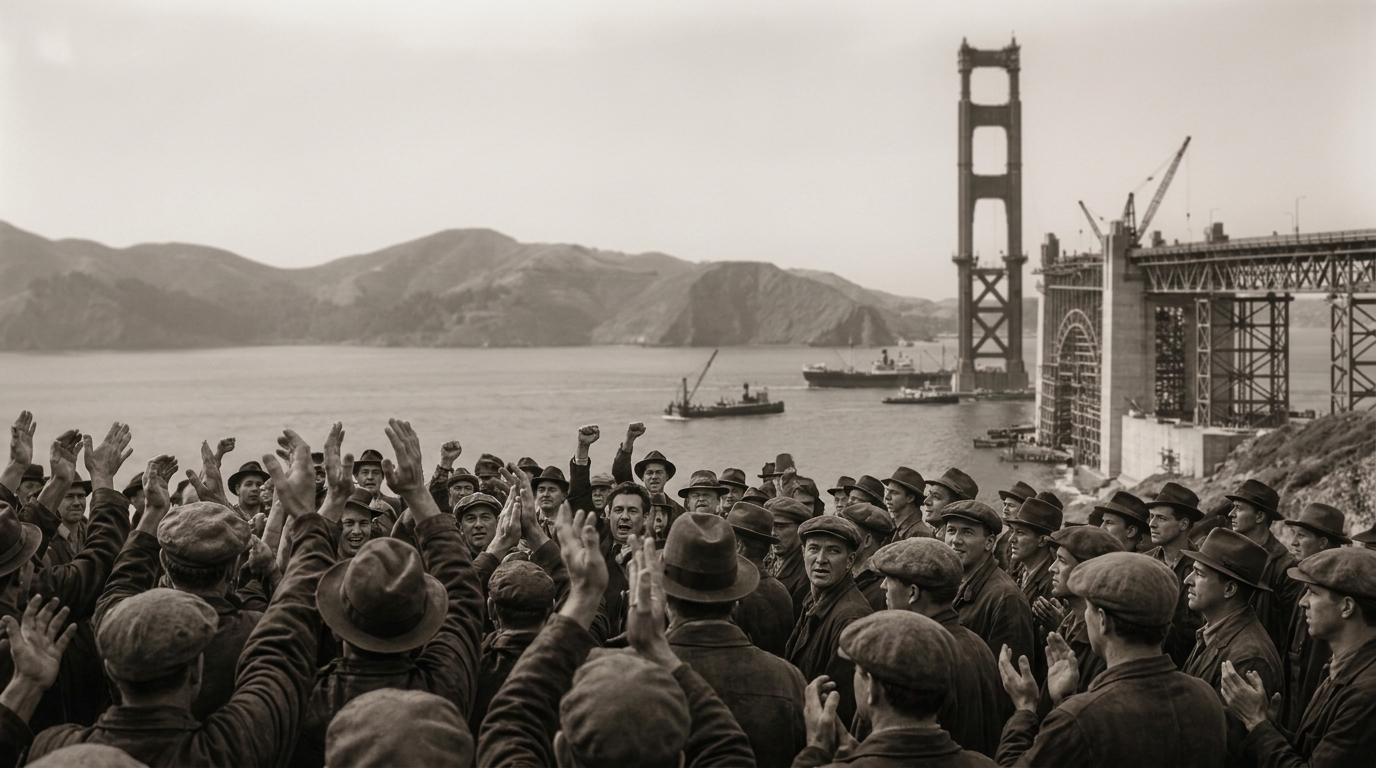
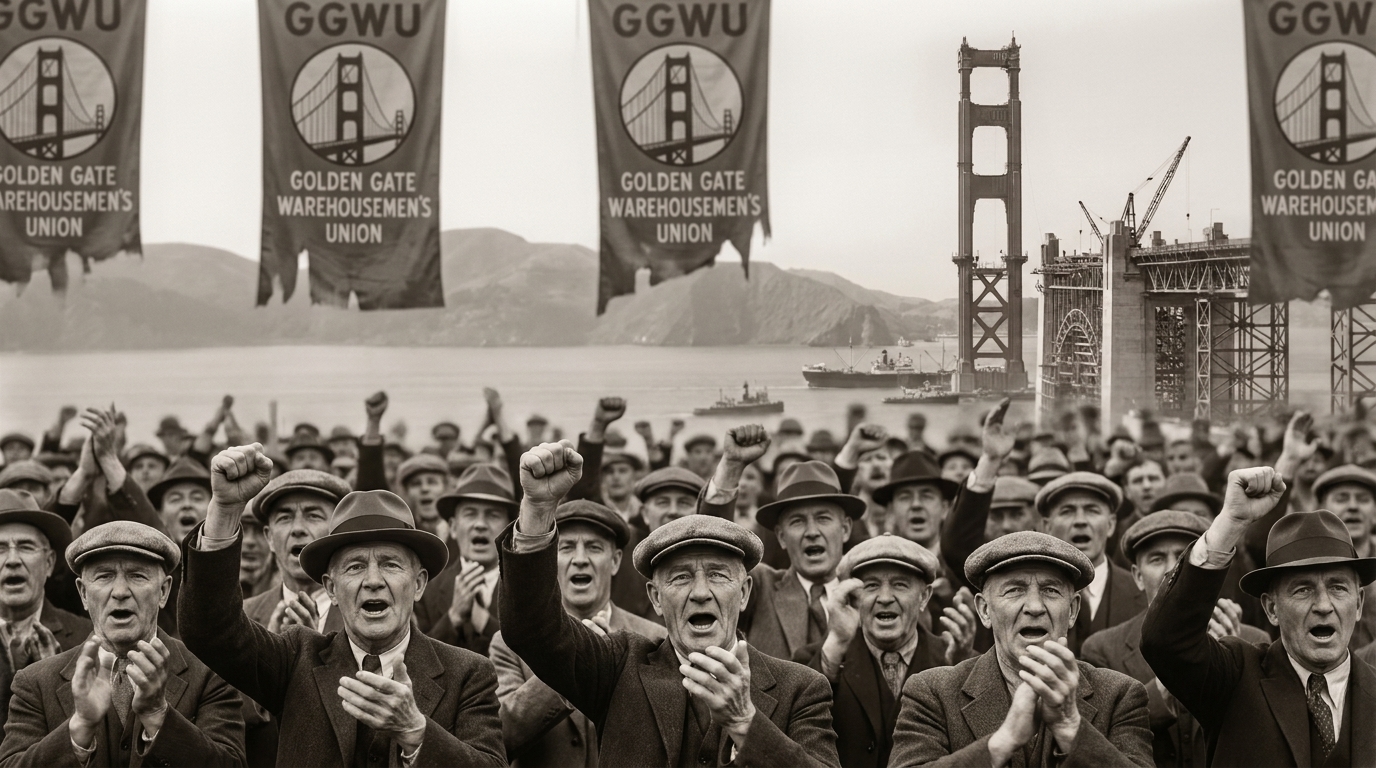
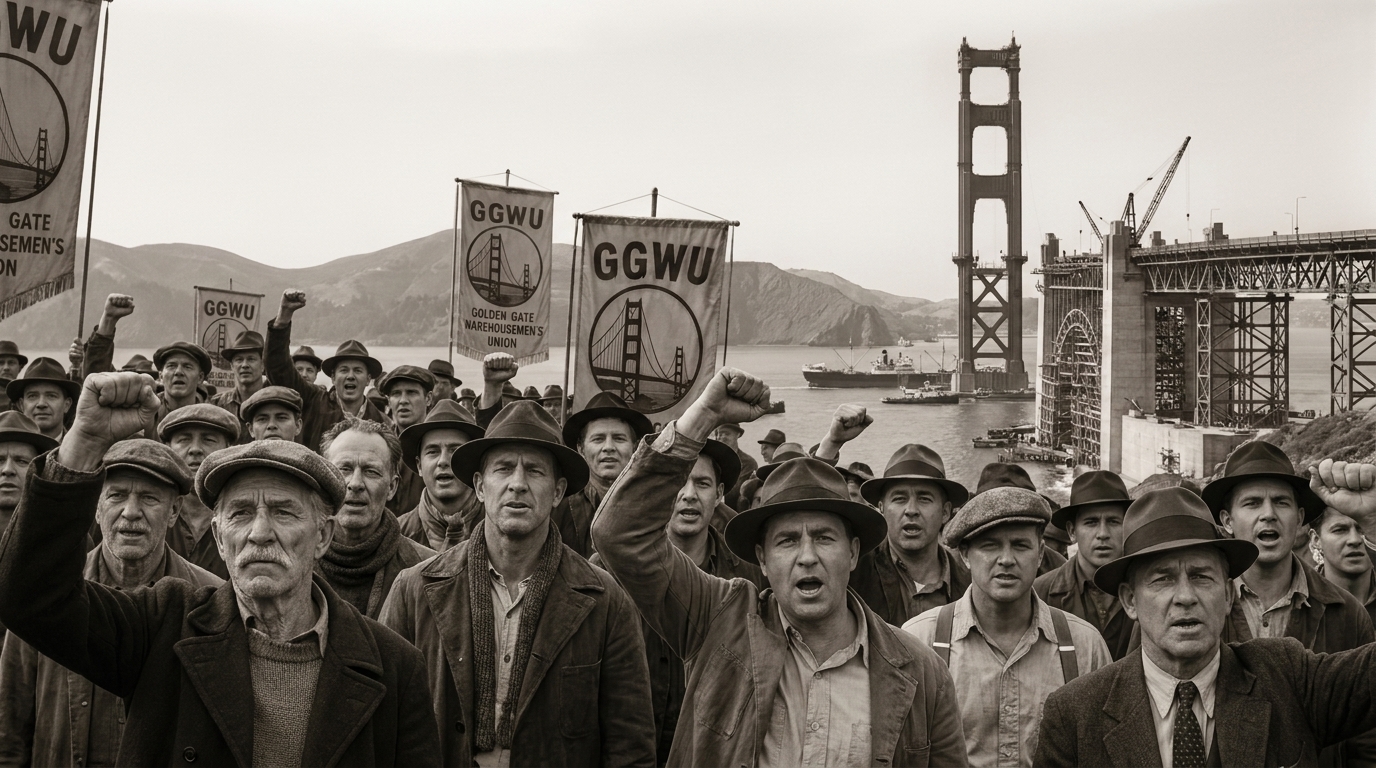
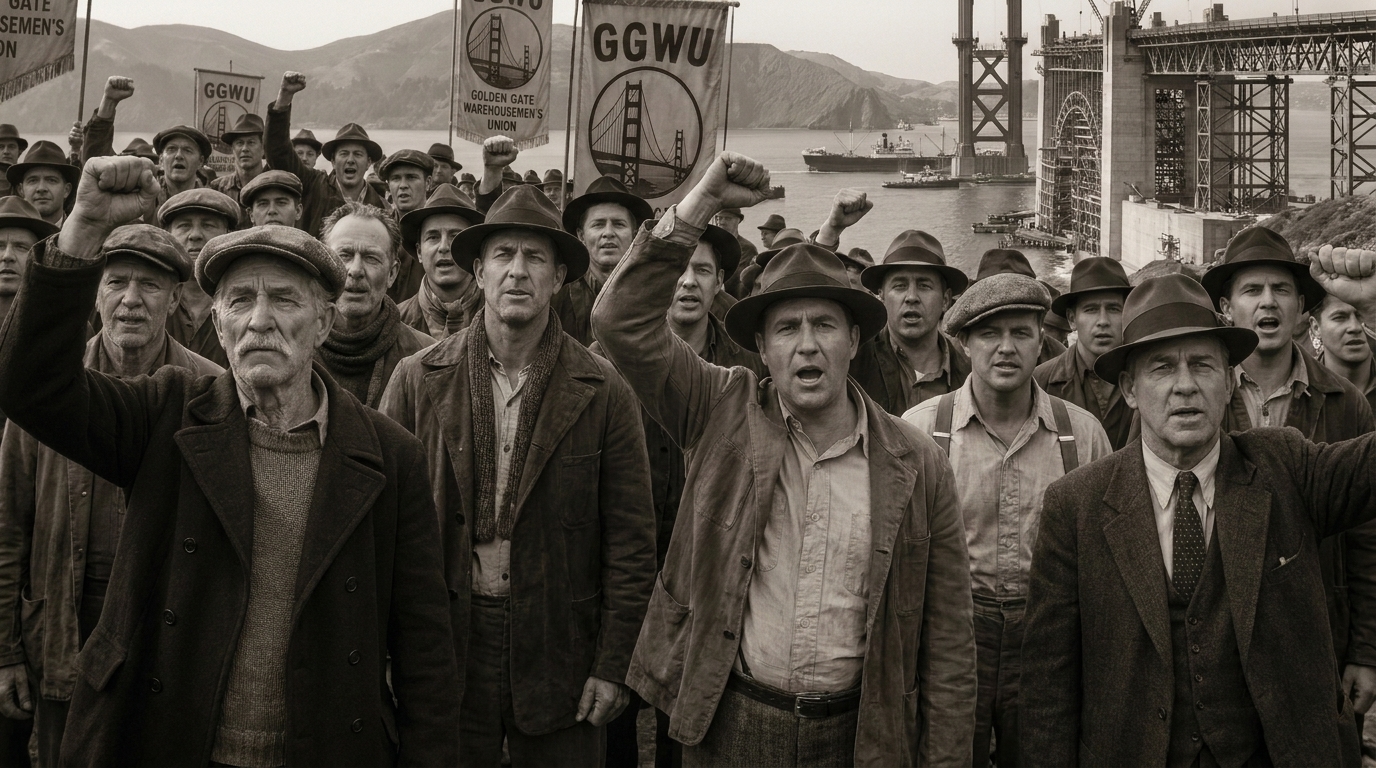
- The camera position: extreme low close-up from inside the front row of the rally crowd, lens about 3 feet from the ground, only 2-4 feet from the nearest faces, looking slightly upward through chins, mouths, noses, cap brims, shoulders, and raised hands. Do NOT pull the camera back.
- The frame priority: ~95 percent of the frame is close human faces, hats, collars, shoulders, hands, fists. Some faces are partial at edges, cap brims cut across the top, shoulders/hands cut across the bottom.
- Every individual worker as rendered in reference image 1: the prominent older mustachioed man on the lower left, the central middle-aged man in the flat cap, every other distinctive face/hat/coat - all preserved.
- The variety of hats (flat caps, newsboy caps, fedoras, brimmed work hats, bare heads) and coats already present.
- The raised fists, the open-mouth cheering expressions.
- The single unfinished Golden Gate Bridge tower visible at the upper right edge. ONE tower only - no second tower, no completed span.
- The warm sepia / silver-brown photographic tonality.
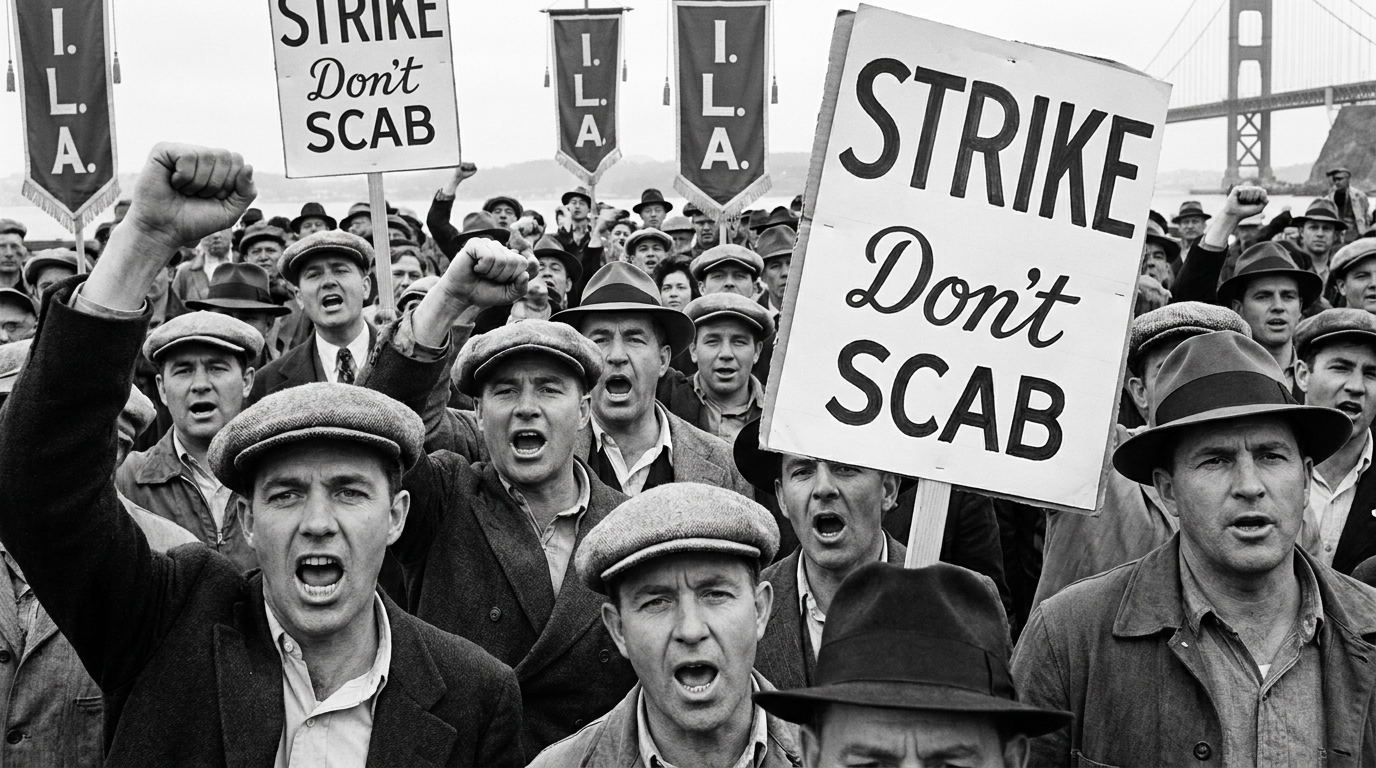
REFERENCE IMAGE 2 IS THE BANNER + PLACARD STYLE MASTER (from approved shot 1):
Reference image 2 shows the cream/ivory cloth ILA banners with dark stitched "I.L.A." block letters at the top, embroidered BLANK ribbon-flag motif with cloud scrollwork in the center (NO text inside the flag), and stitched "INTERNATIONAL LONGSHOREMEN'S ASSOCIATION" along the bottom. It also shows the single hand-painted STRIKE / Don't / SCAB placard with three lines stacked on the same single card. Use these designs as the authoritative source.
CHANGE 1 - REPLACE THE GGWU BANNER FRAGMENTS WITH ILA BANNER FRAGMENTS:
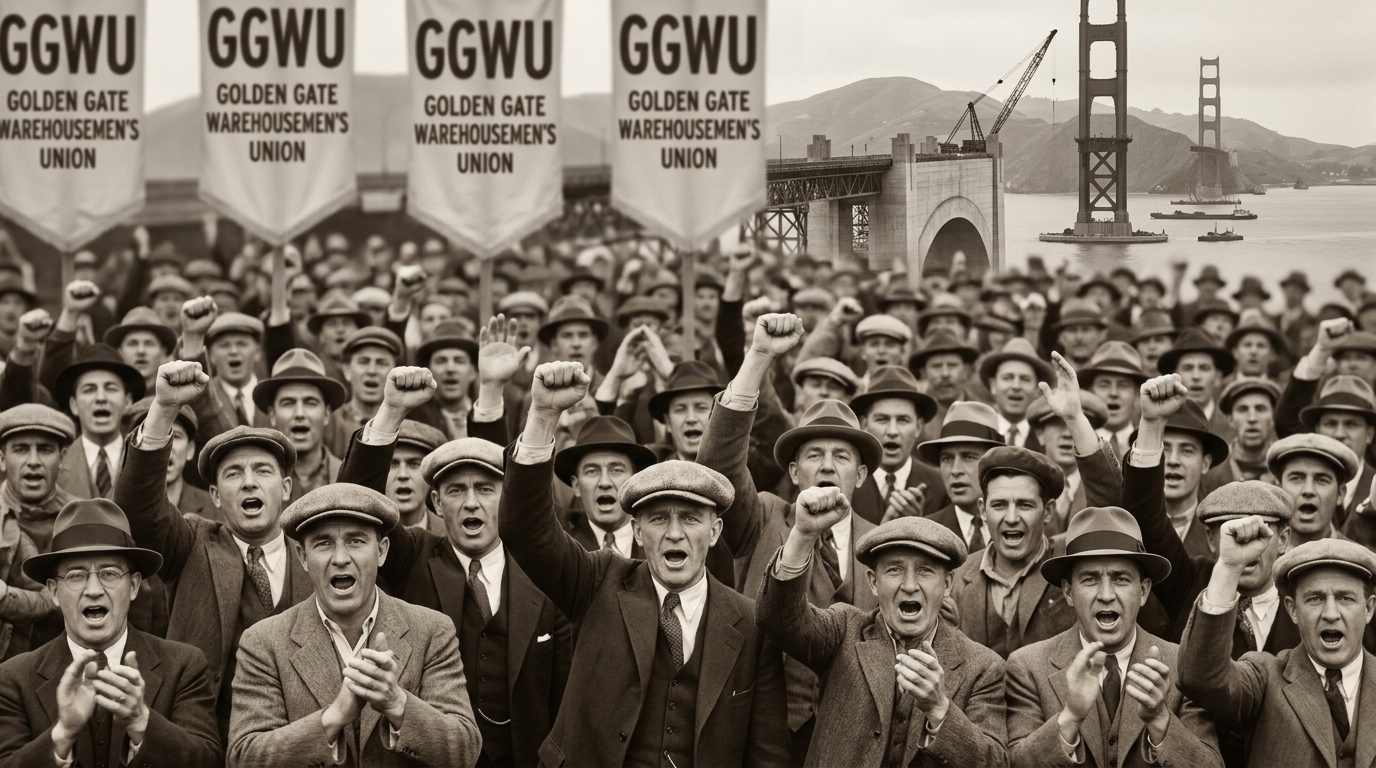
Reference image 1 has GGWU banner fragments visible at the top edge of the frame, showing the circular Golden Gate Bridge logo and "GGWU" / "GOLDEN GATE WAREHOUSEMEN'S UNION" text. Replace these banner fragments 1:1 in their EXACT same positions and sizes with the ILA banner fragments from reference image 2:
- cream/ivory cloth
- dark stitched "I.L.A." block capitals (where visible at top of banner fragments)
- embroidered BLANK ribbon-flag motif with cloud scrollwork (where visible in middle)
- stitched "INTERNATIONAL LONGSHOREMEN'S ASSOCIATION" text (where visible at bottom)
- same poles, same hanging tassels, same drape
The banners remain background-only - tiny cropped fragments behind heads at the top of the frame. Do NOT enlarge them. Do NOT add new banners. Do NOT bring the banners forward.
CHANGE 2 - ADD ONE HAND-PAINTED STRIKE PLACARD AMONG THE RAISED FISTS:
Add EXACTLY ONE hand-painted STRIKE / Don't / SCAB placard held up by one of the workers in the crowd, modeled on the placard in reference image 2:
- a single rectangular piece of white card stock or thin plywood
- ALL THREE LINES stacked on the SAME card: "STRIKE" block capitals top, "Don't" cursive middle, "SCAB" block capitals bottom
- held above shoulders by one worker, partially visible at a tilt among the raised fists in the upper middle or upper right area of the frame
- sized about the same as a worker's head from this close camera distance - LARGE in the frame because we are close, but NOT dominating the frame, NOT in the foreground, NOT obscuring any of the prominent faces
Only ONE placard total. Do NOT split STRIKE / Don't / SCAB across multiple cards. Do NOT add more than one placard.
STRICT DO-NOT LIST:
- Do NOT change the camera angle, height, distance, crop, scale, or composition.
- Do NOT replace any of the individual faces, hats, or coats in reference image 1.
- Do NOT change the bridge tower (one tower only, same upper-right position).
- Do NOT pull back to a wide rally shot.
- Do NOT bring the banners forward or enlarge them.
- Do NOT add more than one placard.
STYLE:
Clean archival 1933 photographic still, warm sepia / silver-brown tonality, sharp documentary press-photo look. NO film grain, NO dust, NO scratches, NO vignette, NO gate weave, NO emulsion damage.
Video prompt (Wan 2.2 / I2V)
Very low, very close crowd shot from the new keyframe. The camera is embedded at about 3 feet high and only a few feet from the nearest dockworker faces, slightly looking upward. Faces, hats, mouths, collars, hands, and fists fill almost the entire frame, with aggressive edge cropping and staggered depths. Preserve high variation in faces, hats, coats, ages, expressions, and postures. Hands clap close to the lens, mouths cheer silently, and scattered fists rise unevenly above the camera. Background banners are tiny cropped fragments only; the bridge is absent or just a soft far-right sliver. Clean keyframe-matched 1933 documentary motion; archival film artifacts are not decided yet.